


240 Drives like a dream on highway, stalls below 15 MPH?


Thread Starter
|
Member
Joined: Sep 2010
Posts: 52
Likes: 1
From: In my car
 240 Drives like a dream on highway, stalls below 15 MPH?
I've seen this question pop up a couple of times but have rarely seen many direct answers. I hate to make a thread with a title that probably looks very familiar to so many of you.. but my problem seems very unusual to me.
Story: Bought car about a month ago, 186k miles, seems to be beautifully maintained and properly serviced, has been driving nicely! About a week ago it started have a problem in which you would go to start the car and it would crank longer than usual, stall the first time.. 5 seconds of waiting, second attempt, and bingo, successful start. Didn't think much of that problem.
Today I drove to Ocean City New Jersey and back, it was about a 3 hour round trip.. I was coming down a ramp into Philadelphia (not my favorite place to break down), and car stalled. I waited about 15 minutes with car off, started in once more, finished my hour and a half of my trip no issues.. on the way home it was a different story as the problem became increasingly more frequent, as I found that any time below 15MPH she'd stall out.. However, the car had plenty of power and drove great anywhere from 45-70MPH. I was a little confused by that and feel that if the fuel pump was going bad, it wouldn't be able to operate so well at high speeds?
I'm not looking for an easy way out or direct instructions. I really just want to know where to start looking for the culprit.
Side note, will a 1993 850 fuel pressure regulator work on a 1991 240? I was going to swap those out to see if the 240's was bad, seeing as how the line that goes from the regulator to the manifold was moist, with gasoline? I believe.. anyway thanks in advance for any suggestions!
Story: Bought car about a month ago, 186k miles, seems to be beautifully maintained and properly serviced, has been driving nicely! About a week ago it started have a problem in which you would go to start the car and it would crank longer than usual, stall the first time.. 5 seconds of waiting, second attempt, and bingo, successful start. Didn't think much of that problem.
Today I drove to Ocean City New Jersey and back, it was about a 3 hour round trip.. I was coming down a ramp into Philadelphia (not my favorite place to break down), and car stalled. I waited about 15 minutes with car off, started in once more, finished my hour and a half of my trip no issues.. on the way home it was a different story as the problem became increasingly more frequent, as I found that any time below 15MPH she'd stall out.. However, the car had plenty of power and drove great anywhere from 45-70MPH. I was a little confused by that and feel that if the fuel pump was going bad, it wouldn't be able to operate so well at high speeds?
I'm not looking for an easy way out or direct instructions. I really just want to know where to start looking for the culprit.
Side note, will a 1993 850 fuel pressure regulator work on a 1991 240? I was going to swap those out to see if the 240's was bad, seeing as how the line that goes from the regulator to the manifold was moist, with gasoline? I believe.. anyway thanks in advance for any suggestions!

no mo volvo
Joined: Oct 2010
Posts: 11,289
Likes: 109
From: 37 North on the left coast
well, if the fuel pressure regulator is failing, then by all means replace that before you do anything else, as that very well could be ALL your problems.
a 240/740/940 should have a rock steady idle of about 600-700rpm once warmed up. if it doesn't, and the car is otherwise running fine, then either the idle switch is bad or the idle control valve is gummed up or otherwise failing, or there's vacuum or intake air leaks
also, it should start with NO gas pedal at all. ours usually kick over on less than 1 second of cranking, even when cold.
a 1991 240 is LH 2.4 and should have the diagnostic LED and jumper block near hte left strut tower under the hood... See Engine and OBD Diagnostic Codes for info on how to read these codes and what they might mean. note that late 740s and most 940s are virtually identical to your late 240, the only major difference is, the 240 doesn't have (or need) the 'radio suppression relay', and the relays you do have are all in different places.
edit: oh. I kinda doubt the 850 fuel pressure regulator fits the 240, its a completely different engine, with a much newer Motronic fuel injection system.
a 240/740/940 should have a rock steady idle of about 600-700rpm once warmed up. if it doesn't, and the car is otherwise running fine, then either the idle switch is bad or the idle control valve is gummed up or otherwise failing, or there's vacuum or intake air leaks
also, it should start with NO gas pedal at all. ours usually kick over on less than 1 second of cranking, even when cold.
a 1991 240 is LH 2.4 and should have the diagnostic LED and jumper block near hte left strut tower under the hood... See Engine and OBD Diagnostic Codes for info on how to read these codes and what they might mean. note that late 740s and most 940s are virtually identical to your late 240, the only major difference is, the 240 doesn't have (or need) the 'radio suppression relay', and the relays you do have are all in different places.
edit: oh. I kinda doubt the 850 fuel pressure regulator fits the 240, its a completely different engine, with a much newer Motronic fuel injection system.

Senior Member
Joined: May 2012
Posts: 184
Likes: 0
That diagnostic box is a life saver!
BTW I got mine at Capital Auto Auction right off Interstate 95, got to the 676/76 split and she started to sputter, back up to speed it was fine. Got to the 76/422 connection in KOP, sputter again. Got to Collegeville exit off 422 (stopping for lunch) and stalled out, would restart but stalled out after a few minutes, towed back home
But running good now.
BTW I got mine at Capital Auto Auction right off Interstate 95, got to the 676/76 split and she started to sputter, back up to speed it was fine. Got to the 76/422 connection in KOP, sputter again. Got to Collegeville exit off 422 (stopping for lunch) and stalled out, would restart but stalled out after a few minutes, towed back home
But running good now.
Last edited by nuclearseal; Aug 11, 2012 at 12:33 AM.
Thread Starter
|
Member
Joined: Sep 2010
Posts: 52
Likes: 1
From: In my car
That is really funny because my car was stalling at every place you mentioned! Well actually, I stalled in the toll booth after the Walt Whitman Bridge. That wasn't fun.
Just a follow up for anyone who may be having a similar problem, CHECK YOUR VACUUM LINE FOR GASOLINE. The one going from your fuel pressure regulator to your air intake manifold. If there is gasoline in it, replace your FUEL PRESSURE REGULATOR. I did this and my problem I explained in my first post has since vanished. Thanks for the replies! EDIT: Also resolved starting delay, cranks for half a second and fires up strong, no more sputters!
Just a follow up for anyone who may be having a similar problem, CHECK YOUR VACUUM LINE FOR GASOLINE. The one going from your fuel pressure regulator to your air intake manifold. If there is gasoline in it, replace your FUEL PRESSURE REGULATOR. I did this and my problem I explained in my first post has since vanished. Thanks for the replies! EDIT: Also resolved starting delay, cranks for half a second and fires up strong, no more sputters!
no mo volvo
Joined: Oct 2010
Posts: 11,289
Likes: 109
From: 37 North on the left coast
ah yes. that vacuum line is used to fine tune the fuel pressure... high vacuum, less absolute fuel pressure. low vacuum (eg, wide open), higher absolute fuel pressure. if the diagram ruptures, then fuel gets into that vacuum line, and your fuel pressure goes to heck. iideal fuel pressure for LH systems is 42 PSI above manifold vacuum.

Junior Member
Joined: Aug 2012
Posts: 2
Likes: 0
well, if the fuel pressure regulator is failing, then by all means replace that before you do anything else, as that very well could be ALL your problems.
a 240/740/940 should have a rock steady idle of about 600-700rpm once warmed up. if it doesn't, and the car is otherwise running fine, then either the idle switch is bad or the idle control valve is gummed up or otherwise failing, or there's vacuum or intake air leaks
also, it should start with NO gas pedal at all. ours usually kick over on less than 1 second of cranking, even when cold.
a 1991 240 is LH 2.4 and should have the diagnostic LED and jumper block near hte left strut tower under the hood... See Engine and OBD Diagnostic Codes for info on how to read these codes and what they might mean. note that late 740s and most 940s are virtually identical to your late 240, the only major difference is, the 240 doesn't have (or need) the 'radio suppression relay', and the relays you do have are all in different places.
edit: oh. I kinda doubt the 850 fuel pressure regulator fits the 240, its a completely different engine, with a much newer Motronic fuel injection system.
a 240/740/940 should have a rock steady idle of about 600-700rpm once warmed up. if it doesn't, and the car is otherwise running fine, then either the idle switch is bad or the idle control valve is gummed up or otherwise failing, or there's vacuum or intake air leaks
also, it should start with NO gas pedal at all. ours usually kick over on less than 1 second of cranking, even when cold.
a 1991 240 is LH 2.4 and should have the diagnostic LED and jumper block near hte left strut tower under the hood... See Engine and OBD Diagnostic Codes for info on how to read these codes and what they might mean. note that late 740s and most 940s are virtually identical to your late 240, the only major difference is, the 240 doesn't have (or need) the 'radio suppression relay', and the relays you do have are all in different places.
edit: oh. I kinda doubt the 850 fuel pressure regulator fits the 240, its a completely different engine, with a much newer Motronic fuel injection system.
Very informative thread. I often have to pump the gas pedal a few times to get my 240 started, always in hot weather. If you don't mind, why do you think my car needs the gas pedal to start? I'm not mechanically inclined so please excuse my ignorance.

My car has also developed a stalling problem over the past couple days, similar to the OP (maybe because we all live in eastern Pennsylvania? j/k). Up until now it ran like a champ (only issue was the frequent pedal pumping to get it started), but now it stalls intermittently while driving slow or at a stop...very strange. Idles a little rough, but fine when you manage to get it running. Sometimes immediately after getting into gear it'll quit. Other times it'll quit less than a mile down the road. I'll try replacing the fuel pressure regulator. Thank you for the insights, LOVEvolvos.
Stalled 2 or 3 times in the parking lot and almost left me stranded at the grocery store tonight, but luckily I was able to bring it back to life after waiting a few minutes to start again. My furious pedal pumping didn't help, I'm sure.
 Now I know to take it easier...
Wonder if I caused any long-term damage...
Last edited by Dinhski; Aug 20, 2012 at 01:31 AM.
no mo volvo
Joined: Oct 2010
Posts: 11,289
Likes: 109
From: 37 North on the left coast
dinhski: what year is your 240? if its got LH2.4 (1988 or newer), I'd be curious if there's any error codes on the on-board diagnostics.
otherwise, I dunno, maybe it just needs a 'tuneup' (mostly, new spark plugs, wires, distributor cap and rotor), maybe there's a fuel system problem, a tired fuel pump or something, or it could be most anything. sounds like an experienced volvo mechanic needs to give it a good look and diagnose what ails it, as if you're not mechanically inclined, there's not much you can do..
otherwise, I dunno, maybe it just needs a 'tuneup' (mostly, new spark plugs, wires, distributor cap and rotor), maybe there's a fuel system problem, a tired fuel pump or something, or it could be most anything. sounds like an experienced volvo mechanic needs to give it a good look and diagnose what ails it, as if you're not mechanically inclined, there's not much you can do..
Junior Member
Joined: Aug 2012
Posts: 2
Likes: 0
Thanks for the reply Pierce. My Volvo is a 92', and it's basically been sitting in the driveway since I made my last post.
Based on information found in another thread I determined that the crank position sensor is going bad (I jiggled mine while the car was idling, and it stalled instantly), but that doesn't seem to explain why I'm having hot-start issues. I have a new crank position sensor and fuel pressure regulator on the way, so hopefully swapping out a couple parts will solve my issues.
Thanks again for your help!
Based on information found in another thread I determined that the crank position sensor is going bad (I jiggled mine while the car was idling, and it stalled instantly), but that doesn't seem to explain why I'm having hot-start issues. I have a new crank position sensor and fuel pressure regulator on the way, so hopefully swapping out a couple parts will solve my issues.
Thanks again for your help!

Banned
Joined: May 2011
Posts: 21
Likes: 0

LoveVolvos,
Thank you for posting your experience. It was very similar to mine and what you found to be the cause enabled me to find the same cause in my '89 240. 124M Miles.
If I could add anything for the benefit of anyone who knows as little as myself, I would emphasize that if the vacuum hose as much as smells of gas one should change the fuel pressure regulator. I had to find the culprit in the act to wake up. This happened when it came to me to pull the vacuum line off the regulator just after a hard start episode...and there it was...gas dripping out of the regulator's nozzle.
By the way, I had a breakdown restart experience at the Jersey side toll plaza of the George Washington Bridge.
And thanks to all who contribute to this forum!
Thank you for posting your experience. It was very similar to mine and what you found to be the cause enabled me to find the same cause in my '89 240. 124M Miles.
If I could add anything for the benefit of anyone who knows as little as myself, I would emphasize that if the vacuum hose as much as smells of gas one should change the fuel pressure regulator. I had to find the culprit in the act to wake up. This happened when it came to me to pull the vacuum line off the regulator just after a hard start episode...and there it was...gas dripping out of the regulator's nozzle.
By the way, I had a breakdown restart experience at the Jersey side toll plaza of the George Washington Bridge.
And thanks to all who contribute to this forum!

Junior Member
Joined: Dec 2012
Posts: 10
Likes: 0
1988 240 dl compression issues...
Hello,
Recently inherited a 88' Volvo 240 dl. Its in great condition. It has been sitting awhile though. It has 134,000 miles. We took it to a local mechanic, and he said that there was low compression in one of the cylinders. Im not sure if he knows what he is talking about though. The car idles low. Also has power issues. But we just drove it this past week and put about 400 miles on it. I had it going between 60 and 70 on the highway. It does not leak fluids of any kind. There is no oil on the engine. We have run about 3 full tanks of gas through it.
Im not sure how to start my own thread, but this discussion seemed to be similar to mine. If anyone can lead me to water, id appreciate it .. Thank you.
Recently inherited a 88' Volvo 240 dl. Its in great condition. It has been sitting awhile though. It has 134,000 miles. We took it to a local mechanic, and he said that there was low compression in one of the cylinders. Im not sure if he knows what he is talking about though. The car idles low. Also has power issues. But we just drove it this past week and put about 400 miles on it. I had it going between 60 and 70 on the highway. It does not leak fluids of any kind. There is no oil on the engine. We have run about 3 full tanks of gas through it.
Im not sure how to start my own thread, but this discussion seemed to be similar to mine. If anyone can lead me to water, id appreciate it .. Thank you.
no mo volvo
Joined: Oct 2010
Posts: 11,289
Likes: 109
From: 37 North on the left coast
Volvo 240, 740 & 940 - Volvo Forums - Volvo Enthusiasts Forum
and click the "New Thread" button near the top of the page, a couple rows under the forum logo.

Last edited by pierce; Dec 31, 2012 at 11:13 PM.

Member
Joined: Feb 2013
Posts: 70
Likes: 2
From: Alameda, CA
 I have this exact same problem
I have read through this entire thread and I think I have the exact same problem. I just bought my 1993 245 from a mechanic who said he was the only one who has worked on it for the past ten years. I had this problem the second day I owned it. I have checked for the click of the idle switch and don't hear or feel a thing. This is definitely something an experienced Volvo mechanic should have noticed.
So, I will give him a chance to fix the problem, but I may be in here for some more advice. I can turn a wrench with the best of them. It's the diagnostics I haven't a clue about.
So, I will give him a chance to fix the problem, but I may be in here for some more advice. I can turn a wrench with the best of them. It's the diagnostics I haven't a clue about.
Member
Joined: Feb 2013
Posts: 70
Likes: 2
From: Alameda, CA

So, I guess I will hijack this thread. My problem may be more electrical but it does have very similar symptoms, so I guess people will be able to compare the two causes of the same problem in one thread.
OK, I've got a 1993 240 Wagon (245) with the LH 2.4. Once the car is warmed up and then I have to drive in crawl-along traffic (lots of cars at a stop sign, in a crowded parking lot, or anywhere in Oakland, CA) it will stall out on me. This seems to happen more often just as I have gone over a bump, but this part may just be selection bias. It will also stall when crawling along on a smooth road.
Last night I checked the OBD codes and got a 1-3-3, which means "Throttle switch idle setting faulty or grounding fault" according to Engine and OBD Diagnostic Codes. When I turned the throttle pulley, I could not hear a click at all.
This afternoon I took it back to the mechanic I bought it from. He stuck his ear up to the thing and swears he hears the switch click. He also disconnected the switch and there was no change in the RPMs. However, I am thinking that if the switch was either broken or maladjusted so that it was always in the normal (not idle) mode, then disconnecting the switch wouldn't have any effect anyway. He practically ignored me when I told him that the OBD gave me a 1-3-3. Instead, he merely adjusted the idle set-screw to increase the idle speed a bit. That reduced the problem enough so that the car is drivable, but I don't think that is a long-term fix.
He also told me to clean the idle control valve and the throttle body. Yeah, I know I could have told him he had to do it because I just bought the thing from him and it is already acting up. However, he is one of the few mechanics I have meet who is willing to work with do-it-yourselfers like me, and he knows I like to do stuff myself, so he just showed me how to take them off and how to adjust the idle set-screw after I had the thing cleaned. So, I am willing to let him slide on that one. Besides, it won't feel like it is "MINE" until I have fixed it.
So ... Is the mechanic blowing smoke about the idle switch? If it is broken or not being thrown (don't know if that would be on or off) when the throttle pulley is twisted, would unplugging it reveal anything at all?
OK, I've got a 1993 240 Wagon (245) with the LH 2.4. Once the car is warmed up and then I have to drive in crawl-along traffic (lots of cars at a stop sign, in a crowded parking lot, or anywhere in Oakland, CA) it will stall out on me. This seems to happen more often just as I have gone over a bump, but this part may just be selection bias. It will also stall when crawling along on a smooth road.
Last night I checked the OBD codes and got a 1-3-3, which means "Throttle switch idle setting faulty or grounding fault" according to Engine and OBD Diagnostic Codes. When I turned the throttle pulley, I could not hear a click at all.
This afternoon I took it back to the mechanic I bought it from. He stuck his ear up to the thing and swears he hears the switch click. He also disconnected the switch and there was no change in the RPMs. However, I am thinking that if the switch was either broken or maladjusted so that it was always in the normal (not idle) mode, then disconnecting the switch wouldn't have any effect anyway. He practically ignored me when I told him that the OBD gave me a 1-3-3. Instead, he merely adjusted the idle set-screw to increase the idle speed a bit. That reduced the problem enough so that the car is drivable, but I don't think that is a long-term fix.
He also told me to clean the idle control valve and the throttle body. Yeah, I know I could have told him he had to do it because I just bought the thing from him and it is already acting up. However, he is one of the few mechanics I have meet who is willing to work with do-it-yourselfers like me, and he knows I like to do stuff myself, so he just showed me how to take them off and how to adjust the idle set-screw after I had the thing cleaned. So, I am willing to let him slide on that one. Besides, it won't feel like it is "MINE" until I have fixed it.
So ... Is the mechanic blowing smoke about the idle switch? If it is broken or not being thrown (don't know if that would be on or off) when the throttle pulley is twisted, would unplugging it reveal anything at all?
no mo volvo
Joined: Oct 2010
Posts: 11,289
Likes: 109
From: 37 North on the left coast
easy to test that switch, disconnect the wires to it, and put a ohm meter across it. should be closed (0 ohm) with the throttle at idle, and should be open (infinite ohm) when the throttle is off idle. according to the wiring diagram, pin 3 is the idle switch, and has a blue-white wire, pin 18 is the common and has a black wire to ground. pin 2 is full throttle, and goes to the ignition controller on your car (I don't think full throttle is nearly as important as idle on these).
and yes, idle controllers do get all gummed up, and cleaning them is a good thing. I'd suggest removing it from the car entirely, and flushing it out with aerosol carb/throttle cleaner... if the rubber hoses to it are crunchy, replace them. the IAC gets power on a red-black wire (same power as goes to the fuel injectors), and the ECU pulses the green-red wire to ground to modulate it. There's a "DTM 3" mode on the OBD diagnostic box on LH2.4 cars that cycles the IAC to test it, you can hook it up while its out of the car, and blow through it while its being pulsed, you should feel the air going stut-stut-stut as it goes click/clack/click/clack by this test mode. see Engine and OBD Diagnostic Codes for how to execute DTM3 with the jumper in pin 2 (DTM3 in pin 6 is an EGR test mode, if your car is so equipped).
while you're at it, clean the throttle body, they get gummed up too. remove it from the car entirely, flush it out with aerosol throttlebody/carb cleaner, make sure all the vacuum ports are clear (blow them out with a bit of compressed air or something. check the condition of all the vacuum lines when you're reassembling it, and replace any that are crunchy or funky.
and yes, idle controllers do get all gummed up, and cleaning them is a good thing. I'd suggest removing it from the car entirely, and flushing it out with aerosol carb/throttle cleaner... if the rubber hoses to it are crunchy, replace them. the IAC gets power on a red-black wire (same power as goes to the fuel injectors), and the ECU pulses the green-red wire to ground to modulate it. There's a "DTM 3" mode on the OBD diagnostic box on LH2.4 cars that cycles the IAC to test it, you can hook it up while its out of the car, and blow through it while its being pulsed, you should feel the air going stut-stut-stut as it goes click/clack/click/clack by this test mode. see Engine and OBD Diagnostic Codes for how to execute DTM3 with the jumper in pin 2 (DTM3 in pin 6 is an EGR test mode, if your car is so equipped).
while you're at it, clean the throttle body, they get gummed up too. remove it from the car entirely, flush it out with aerosol throttlebody/carb cleaner, make sure all the vacuum ports are clear (blow them out with a bit of compressed air or something. check the condition of all the vacuum lines when you're reassembling it, and replace any that are crunchy or funky.
Last edited by pierce; Apr 12, 2013 at 12:13 AM.
Member
Joined: Feb 2013
Posts: 70
Likes: 2
From: Alameda, CA
Hey, there Pierce. Thank you so much for your wonderful information. And while I do have a Bently's service manual on the way, I do have a few questions to clarify:
While it is relatively easy to get the connector off of the switch, the angle of the switch pins (while still mounted in the car) makes them pretty difficult to get to, and especially to see which pin is which. Is there another, more accessible, connector where I could measure these resistances? Or, could you please tell me which order the pins are in going from the top, down - while the stitch is still mounted in position in the car? That would be super helpful.
When, exactly is it supposed to go "off idle"? Should I only have to turn the throttle pulley like 1 degree? Or is 5 degrees considered "off idle"? I'm not sure at which point I should be hearing the click and seeing the resistance change on the meter.
Also, according to this, it does seem that my mechanic IS blowing smoke when he says no reaction to disconnecting the switch means the switch is not the problem. If the switch is supposed to be open when off idle and the switch is broken or maladjusted and thus open all the time, that would indeed cause this poor idle problem. Unplugging the switch would make no difference because it was already open. Sure, the engine may run when in park and under no load, but as soon as I put any load on it at all, it will die (when it is acting up, which is only after it gets good and warmed up) because the Idle Air Controller is then not being opened. And a good Volvo mechanic should know all this.
I also think he is setting me up for failure because he specifically told me to loosen the idle switch when I take the throttle body off to clean it, WITHOUT warning me to, first, carefully mark the idle switch's position on the throttle body. Yet, everything I have read and seen says that you must either mark the position of the switch, before removing it for cleaning or be prepared to adjust it with feeler gauges when putting it back on. So, I think he wants me to screw up the adjustment of the switch, think that I did something wrong out of my own incompetence, and totally give up on doing my own work. That is not gonna happen.
Could you have possibly meant "pin 1" instead of "pin 18"? After all, the '8' is right above the 'i' which is the next letter in your sentence.
Does this mean that the IAC is a solenoid controlled flapper valve? Or is it actually a motor controlled valve which is just run very fast in this test? The answer to this question kind of makes a difference in how much I can trust that mechanic. He called it an "idle motor" and said that it moves very slowly.
Cleaning one thing at a time is all I am up for on my first go on auto repair in a couple of decades. I want to start with the easy stuff. Plus, I want to do one thing at a time so I can try to figure out if there is one thing that just happened to go bad or if this is a problem that has to have been building up over time, and thus one more thing the "only mechanic to have touched this car in ten years" should have known.
As you can probably gather, I am starting to build up a whole list of reasons why I probably shouldn't trust this mechanic.
Again, thanks for all your help, and thanks for reading this long message.
Grant
Also, according to this, it does seem that my mechanic IS blowing smoke when he says no reaction to disconnecting the switch means the switch is not the problem. If the switch is supposed to be open when off idle and the switch is broken or maladjusted and thus open all the time, that would indeed cause this poor idle problem. Unplugging the switch would make no difference because it was already open. Sure, the engine may run when in park and under no load, but as soon as I put any load on it at all, it will die (when it is acting up, which is only after it gets good and warmed up) because the Idle Air Controller is then not being opened. And a good Volvo mechanic should know all this.
I also think he is setting me up for failure because he specifically told me to loosen the idle switch when I take the throttle body off to clean it, WITHOUT warning me to, first, carefully mark the idle switch's position on the throttle body. Yet, everything I have read and seen says that you must either mark the position of the switch, before removing it for cleaning or be prepared to adjust it with feeler gauges when putting it back on. So, I think he wants me to screw up the adjustment of the switch, think that I did something wrong out of my own incompetence, and totally give up on doing my own work. That is not gonna happen.
while you're at it, clean the throttle body, they get gummed up too. remove it from the car entirely, flush it out with aerosol throttlebody/carb cleaner, make sure all the vacuum ports are clear (blow them out with a bit of compressed air or something. check the condition of all the vacuum lines when you're reassembling it, and replace any that are crunchy or funky.
As you can probably gather, I am starting to build up a whole list of reasons why I probably shouldn't trust this mechanic.
Again, thanks for all your help, and thanks for reading this long message.
Grant
no mo volvo
Joined: Oct 2010
Posts: 11,289
Likes: 109
From: 37 North on the left coast
wiring diagram as such:
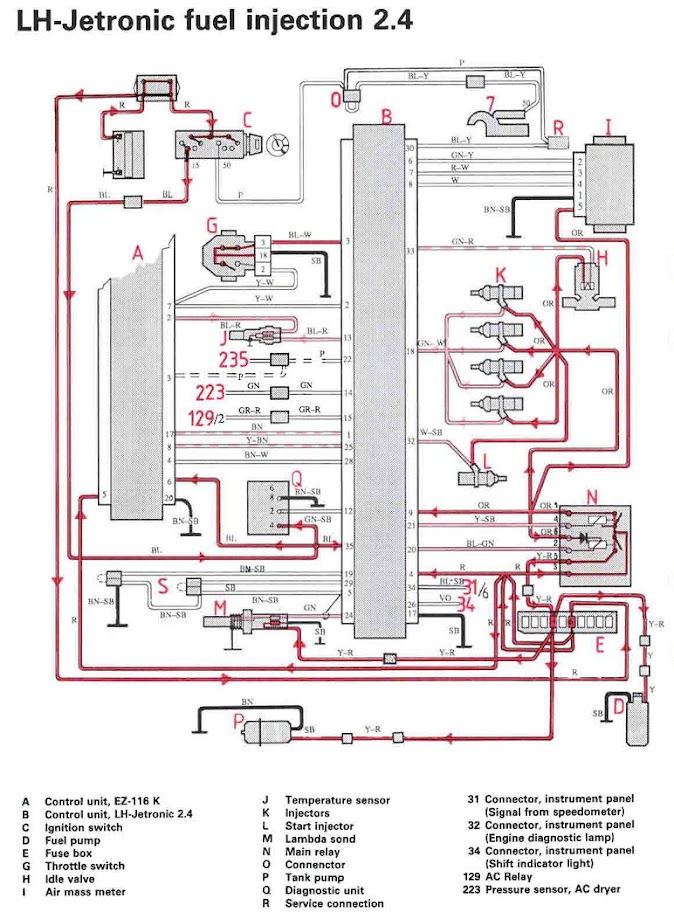
as soon as the throttle actually moves, almost immediately. there's some cable slack before that, of course.
Also, according to this, it does seem that my mechanic IS blowing smoke when he says no reaction to disconnecting the switch means the switch is not the problem. If the switch is supposed to be open when off idle and the switch is broken or maladjusted and thus open all the time, that would indeed cause this poor idle problem. ...

Could you have possibly meant "pin 1" instead of "pin 18"? After all, the '8' is right above the 'i' which is the next letter in your sentence.
Does this mean that the IAC is a solenoid controlled flapper valve?
Cleaning one thing at a time is all I am up for on my first go on auto repair in a couple of decades.
Member
Joined: Feb 2013
Posts: 70
Likes: 2
From: Alameda, CA
Wow! You are an amazing fount of information. I had Googled till I was blue in the face and couldn't find that diagram.
I kinda knew that guy was underhanded.  Yet I just bought a car off of him anyway. I guess I must have really wanted a project car after all. I'm sure it will be a good car after I do a bit of work.
Now, if that don't beat all. I was going to ask who would number pins like that, but then I know the answer is, "Some Swedish guy." 
Under normal circumstances, I would totally agree with you. But I know me, and I only have a bare minimum of tools, and I haven't done any auto work in decades, and I need to be able to have myself covered for all the possible contingencies before I start on something like this because I can't afford to just buy parts or have it towed if something goes wrong. So, I have a lot more research to do before I am ready to do the throttle body, even though I am sure it desperately needs it.
After I have more practice, I'm sure I can do the whole shebang in an afternoon. But you'll just have to forgive me if I move a little slow for now.
Yet I just bought a car off of him anyway. I guess I must have really wanted a project car after all. I'm sure it will be a good car after I do a bit of work. I dunno. its easier to do a bunch of related things together, so you only have to tear into that section once. the idle air controller is half under the throttle body, so you its a lot easier to take out when the throttle body is out. take it all apart, clean the throttle body and idle air controller with throttle body cleaner while working the mechanisms... while you're in there, the oil separator box and flame trap are down there too, thats something that should be checked and cleaned out every few years, and is easier to get at that when the idle air controller and hoses are already out.
After I have more practice, I'm sure I can do the whole shebang in an afternoon. But you'll just have to forgive me if I move a little slow for now.
no mo volvo
Joined: Oct 2010
Posts: 11,289
Likes: 109
From: 37 North on the left coast
(from memory) ... draw a diagram of the throttle and all the vacuum lines you can see.
disconnect the vacuum lines that go to the throttle body. disconnect the little pushrod that goes from the throttle drum to the throttle (I think its a pushrod on these cars, I might be mixing up things). unplug the throttle switch. loosen the clamps on on the throttle, pull the plastic/rubber air boot off the in side, unbolt and pull the throttle off the manifold. I forget if the idle air tube goes directly to the throttle body or the manifold, but that gets disconnected to. put the throttle aside (updating your drawing with anything you think you'll need to remember).
disconnect the idle air controller's electreical connector, and tubes, unbolt and remove it., draw what you need, put it aside. I lay parts in the orientation they go together on sheet of paper on a small table I setup next to the vehicle. or on the garage floor, if you have one.
pull the flame trap vent hose off, do the flame trap clean thing (** link). its right there where you can get to it. put the flame trap and hoses back together.
clean throttle body, clean idle air controller. 1 can of throttle cleaner spray should be plenty to do both and have a half can left over.
for extra points, connect IAC's plug, and run "DTM3" in jumper 2, and see if the IAC cycles when its its turn. {*** linkie)
replace the idle air controller, reconnect.
reinstall the throttle body, reattach air pipe, clamps, throttle rod, electrical connector to idle switch, and vacuum lines.
drink a "Arrogant Bastard Ale" ("YOU'RE NOT WORTHY!" it says on the label!), or other beverage of choice and congrats for a job well done.
{**) The "flame trap" is this little filter disk with a punch of holes in the crankcase ventilation system, in a plastic 'oil seperator box' thats on the side of the motor underneath the intake manifold, and connected to a medium sized rubber hose thing that feeds the fumes back into the engine. This thing plugs up, then your engine blows its seals. See Engine. Seals, Belts, Crankcase Ventilation for all the gory details in marvelous black and white.
(***) DTM3 - Diagnostic Test Mode 3. magic sequence of jumepr and button pushing with the diagnostic jumper in #2, and the ECU goes through a sequence of testing stuff, electric fan high-low-high-low (if you have one). idle air controller on-off-on-off-on-off. fuel injectors on-off-on-off. etc, repeat. ignore the other tests, but when its IAC time, blow into one end and see if your air goes ON-OFF-ON-OFF... if so, its WORKING! see Engine and OBD Diagnostic Codes
disconnect the vacuum lines that go to the throttle body. disconnect the little pushrod that goes from the throttle drum to the throttle (I think its a pushrod on these cars, I might be mixing up things). unplug the throttle switch. loosen the clamps on on the throttle, pull the plastic/rubber air boot off the in side, unbolt and pull the throttle off the manifold. I forget if the idle air tube goes directly to the throttle body or the manifold, but that gets disconnected to. put the throttle aside (updating your drawing with anything you think you'll need to remember).
disconnect the idle air controller's electreical connector, and tubes, unbolt and remove it., draw what you need, put it aside. I lay parts in the orientation they go together on sheet of paper on a small table I setup next to the vehicle. or on the garage floor, if you have one.
pull the flame trap vent hose off, do the flame trap clean thing (** link). its right there where you can get to it. put the flame trap and hoses back together.
clean throttle body, clean idle air controller. 1 can of throttle cleaner spray should be plenty to do both and have a half can left over.
for extra points, connect IAC's plug, and run "DTM3" in jumper 2, and see if the IAC cycles when its its turn. {*** linkie)
replace the idle air controller, reconnect.
reinstall the throttle body, reattach air pipe, clamps, throttle rod, electrical connector to idle switch, and vacuum lines.
drink a "Arrogant Bastard Ale" ("YOU'RE NOT WORTHY!" it says on the label!), or other beverage of choice and congrats for a job well done.
{**) The "flame trap" is this little filter disk with a punch of holes in the crankcase ventilation system, in a plastic 'oil seperator box' thats on the side of the motor underneath the intake manifold, and connected to a medium sized rubber hose thing that feeds the fumes back into the engine. This thing plugs up, then your engine blows its seals. See Engine. Seals, Belts, Crankcase Ventilation for all the gory details in marvelous black and white.
(***) DTM3 - Diagnostic Test Mode 3. magic sequence of jumepr and button pushing with the diagnostic jumper in #2, and the ECU goes through a sequence of testing stuff, electric fan high-low-high-low (if you have one). idle air controller on-off-on-off-on-off. fuel injectors on-off-on-off. etc, repeat. ignore the other tests, but when its IAC time, blow into one end and see if your air goes ON-OFF-ON-OFF... if so, its WORKING! see Engine and OBD Diagnostic Codes
Member
Joined: Feb 2013
Posts: 70
Likes: 2
From: Alameda, CA
 A dribble of an update........
OK, I hadn't wanted to post again until I had some real news. I discovered that I had schrader valves on my fuel line just before the main pump and on the fuel rail. So I ordered a fuel pressure gauge (which I discuss in another thread). I received my new fuel pressure gauge today. I had difficulty getting it on the schrader valve on the fuel line, but was able to get it on the test port on the fuel line just before my main fuel pump.
I got ZERO psi. I double-checked all kinds of ways. I even went as far as to take everything off and depress the valve release on the schrader valve with a key. All I could get was a tiny dribble of fuel. Barely enough to get my hand wet and drip onto the ground. The way I see it, if there were any pressure at all in that line, then it would have at least squirted a little bit. In fact, it really seemed as if it was sucking air at times. Enough to cause the engine to sputter.
After I was all packed up and writing about the fuel pressure gauge in that other thread, I realized that I could just shut off the car, pull the valve stem all the way out, slap that gauge back on there, and start the car to get a reading. I will try that tomorrow, but I am pretty sure I will get the same result.
So, I am pretty sure that the transfer pump (the one in the tank) is not running. This is entirely consistent with all my symptoms. Stalling at crawl along speed once warmed up, but not when in idle and out of gear, and NEVER when the engine is still cool. Difficulty getting any real speed going up the super steep hills in Oakland, CA. Needing to really mash the gas pedal to the floor just to get to 70 MPH but then being able to stay there just fine.
Whether the pump is bad or just not getting electricity is the next puzzle. So, because it is a wagon, with the third-row seat, I have a little bit of "construction work" to do in terms of removing the seat and the boards that make up the floor of the bed, before I can get to that pump and the electrical connector, on which I have to take a voltage reading.
I'll let you know what I find out.
I got ZERO psi. I double-checked all kinds of ways. I even went as far as to take everything off and depress the valve release on the schrader valve with a key. All I could get was a tiny dribble of fuel. Barely enough to get my hand wet and drip onto the ground. The way I see it, if there were any pressure at all in that line, then it would have at least squirted a little bit. In fact, it really seemed as if it was sucking air at times. Enough to cause the engine to sputter.
After I was all packed up and writing about the fuel pressure gauge in that other thread, I realized that I could just shut off the car, pull the valve stem all the way out, slap that gauge back on there, and start the car to get a reading. I will try that tomorrow, but I am pretty sure I will get the same result.
So, I am pretty sure that the transfer pump (the one in the tank) is not running. This is entirely consistent with all my symptoms. Stalling at crawl along speed once warmed up, but not when in idle and out of gear, and NEVER when the engine is still cool. Difficulty getting any real speed going up the super steep hills in Oakland, CA. Needing to really mash the gas pedal to the floor just to get to 70 MPH but then being able to stay there just fine.
Whether the pump is bad or just not getting electricity is the next puzzle. So, because it is a wagon, with the third-row seat, I have a little bit of "construction work" to do in terms of removing the seat and the boards that make up the floor of the bed, before I can get to that pump and the electrical connector, on which I have to take a voltage reading.
I'll let you know what I find out.
Last edited by GrantRobertson; Apr 29, 2013 at 11:59 PM.
no mo volvo
Joined: Oct 2010
Posts: 11,289
Likes: 109
From: 37 North on the left coast
oh a 7/9 wagon, at least, you don't need to remove the 3rd row seat, just the floor panels behind the back seats. back seat doesn't have to come out, either.
I'm not sure about a 240 wagon, however.
I'm not sure about a 240 wagon, however.