


Refill Freon on Volvo 240 DL 1990


Thread Starter
|
Senior Member
Joined: Jan 2006
Posts: 249
Likes: 1
From:
 Refill Freon on Volvo 240 DL 1990
I have a slow freon leak in my Volvo 240 1990. It is somewhere in the dashboard because I had a test done on the outside and no leaks showed. Rather than fix the leak which would cost me alot of cash(not trying to be cheap, but been overwhelmed with other bills) is there something that I could buy that would allow me to fill the freon myself with the lowpass?

Super Moderator
Joined: Aug 2008
Posts: 2,580
Likes: 9
From: Dallas, TX
Depends. If your car has been converted to R134a, you can easily add refrigerant. If it's R12 still, you'll most likely have to use a pro. R12 is 80-100 a can these days. Doesn't seem too smart to use R12 with a known leak.
Super Moderator
Joined: Aug 2008
Posts: 2,580
Likes: 9
From: Dallas, TX
The issue of course, is not the refrigerant but the oil used for lubrication in the system. R12 systems used mineral oil which will not carry with R134a; the compressor will be oil starved and soon die from lack of lube. New vehicles, with R134a from the factory, use PAG oil which is not compatible with mineral oil...it forms nasty goop. The solution is to use ester oils which are compatible with both refrigerants; this is the oil all shops use today when doing retrofits. R134a attacking o-rings in R12 systems is an old wives tale from the early days of conversions. As I said, if your car has not been converted to R134a, the best option is to take it to a shop and have them at least evacuate the system to get as much of the old oil out and pull a vacuum for you. Then you can go home and add your own R134a, using the adapter fitting the shop put on to pull the vacuum. All you need is a low side conversion fitting...$2 or 3 bucks. Besides some variety of leak seal, you might consider a can with dye in it so someone can find the leak at some point.
Thread Starter
|
Senior Member
Joined: Jan 2006
Posts: 249
Likes: 1
From:
when I bought the car I was told the AC had been convertered. I was told to fill the AC you had to use the low pass, but since the Volvo 240 DL low pass valve was diff. than most I had to take it to a mechanic shop to have it filled(which I did last summer which was $240.00 w the leak test). So, if my AC has been converted all I have to do is buy an adapter for the low pass to fill it with R134a myslef? That is great! Thank you! What adapter do I look for or where do I find it?
Thanks,
-Dman
Thanks,
-Dman
Super Moderator
Joined: Aug 2008
Posts: 2,580
Likes: 9
From: Dallas, TX
If the system has been converted, odds are you do not need an adapter. R12 used Shraeder fill valves, like on a bicycle tire. To keep people from mixing R134a and R12, they came out with a larger diameter, lock ring type fitting similar to air tool/air hose connections. To install the adapter, you simply screw it onto the existing low side Shraeder valve. On 240's, simply look on the backside of the compressor; both high and low pressure valves are there. Generally, the valves are difficult to access. In the following picture, just to the right of the two hoses you'll see a fitting w/ a blue cap. Note that it is a 90 degree fitting w/ the cap pointing up. I added that fitting to be able to access the low side easier...available at most any NAPA. The picture is of a B20 motor, but the compressor is the same as on your 240. Always note: Do not fill on the high side. Blue cap means low side, red cap means high side. Big hose = low pressure, little hose equal high pressure.

Last edited by swiftjustice44; May 30, 2011 at 06:33 AM.

Senior Member
Joined: Mar 2011
Posts: 103
Likes: 0
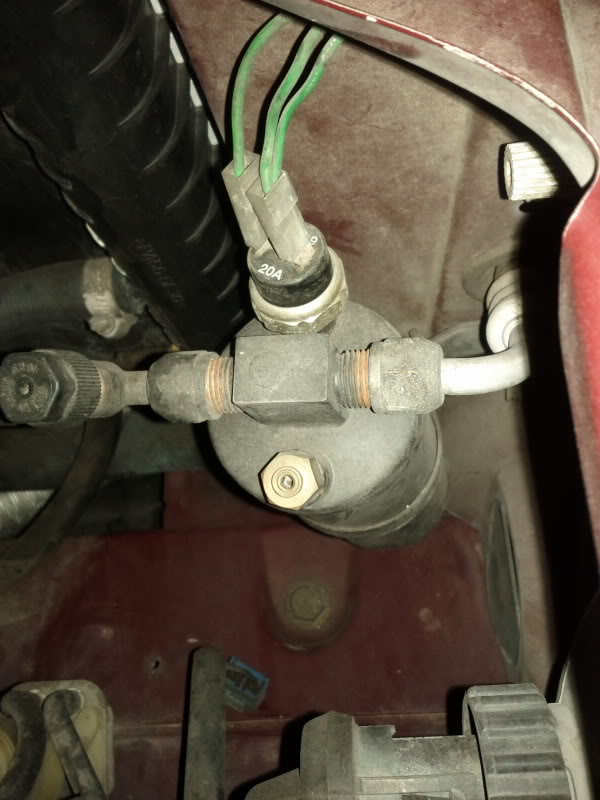
Hey, since the 2xx/7xx are accumulator/orifice systems can't you access the low side from the fitting on the right side of the accumulator? To be honest I've been wondering where the hell the high side port is. I know it's dangerous giving the info to diy-ers, but I have access to an a/c machine and a dead unconverted 740.



Super Moderator
Joined: Aug 2008
Posts: 2,580
Likes: 9
From: Dallas, TX
Thats the factory fill location...has no bearing on the situation. In fact, if you are ever in a position where you are having parts replaced, have the tech remove that piece as it is a common source of leaks. On the 90- cars, any retro fitted valve will be on the compressor itself and on the back of the unit as seen in my B20 pic above. The difference is, on an 86+ B230 240, the compressor is under the p/s pump.
And, to answer an earlier comment, 240's did not have accumulators/orifice setups. They used the expansion valve type.
And, to answer an earlier comment, 240's did not have accumulators/orifice setups. They used the expansion valve type.
Last edited by swiftjustice44; May 31, 2011 at 06:52 AM.
Senior Member
Joined: Mar 2011
Posts: 103
Likes: 0
Well, on my 740, which has the accumulator/orifice setup and has a "fill" port on the accumulator and has the famous "u" pipe near the accumulator at least one fitting on the back of the compressor, which should I put the high side on and which should I put the low side on?
Super Moderator
Joined: Aug 2008
Posts: 2,580
Likes: 9
From: Dallas, TX
Well, I double checked...no rwd Volvo used an orifice tube, they're all expansion tube varieties. Low side fittings are generally attached to the accumulator. Often there is a high side fitting separate from the compressor. It's really easy to determine which line is which. The larger diameter hose is always the low side, the smaller hose is always the high side. In the picture I posted on page one, the low side hose is on the driver side (right in the pic) and the high side hose is on the passenger side (left in pic). It's entirely possible to completely service an a/c unit using only the low side. The only advantage of being able to access the high side is to check the manifold gauges while the system is running.
Senior Member
Joined: Mar 2011
Posts: 103
Likes: 0
I know that the service can be completed by only using the low side, but I have access to an A/C machine and I want to pull a GOOD vacuum on the whole system before charging, AND I want to fill without having to run the compressor.
Not trying to be a complete dick, but I'm 100% positive my 740 has an accumulator/ fixed orifice system and NOT an expansion block/valve system.
Orifice Tube
If it was a receiver/dryer system the service port on the receiver/drier would be a high pressure port because a receiver/dryer system works in reverse of an accumulator/orifice system. Either way they serve the same relative purpose to the system, but in different directions I have ordered a new hose, an accumulator, and an orifice tube from FCP. I can take pictures of my disassembly/assembly if you'd like some proof. My understanding is that the orifice tube is in the pipe of the high pressure line going into the evap.
Not trying to be a complete dick, but I'm 100% positive my 740 has an accumulator/ fixed orifice system and NOT an expansion block/valve system.
Orifice Tube
If it was a receiver/dryer system the service port on the receiver/drier would be a high pressure port because a receiver/dryer system works in reverse of an accumulator/orifice system. Either way they serve the same relative purpose to the system, but in different directions I have ordered a new hose, an accumulator, and an orifice tube from FCP. I can take pictures of my disassembly/assembly if you'd like some proof. My understanding is that the orifice tube is in the pipe of the high pressure line going into the evap.
Super Moderator
Joined: Aug 2008
Posts: 2,580
Likes: 9
From: Dallas, TX
I know that the service can be completed by only using the low side, but I have access to an A/C machine and I want to pull a GOOD vacuum on the whole system before charging, AND I want to fill without having to run the compressor.
Not trying to be a complete dick, but I'm 100% positive my 740 has an accumulator/ fixed orifice system and NOT an expansion block/valve system.
Orifice Tube
If it was a receiver/dryer system the service port on the receiver/drier would be a high pressure port because a receiver/dryer system works in reverse of an accumulator/orifice system. Either way they serve the same relative purpose to the system, but in different directions I have ordered a new hose, an accumulator, and an orifice tube from FCP. I can take pictures of my disassembly/assembly if you'd like some proof. My understanding is that the orifice tube is in the pipe of the high pressure line going into the evap.
Not trying to be a complete dick, but I'm 100% positive my 740 has an accumulator/ fixed orifice system and NOT an expansion block/valve system.
Orifice Tube
If it was a receiver/dryer system the service port on the receiver/drier would be a high pressure port because a receiver/dryer system works in reverse of an accumulator/orifice system. Either way they serve the same relative purpose to the system, but in different directions I have ordered a new hose, an accumulator, and an orifice tube from FCP. I can take pictures of my disassembly/assembly if you'd like some proof. My understanding is that the orifice tube is in the pipe of the high pressure line going into the evap.

Senior Member
Joined: Jan 2011
Posts: 1,210
Likes: 14
From: New York
I know that the service can be completed by only using the low side, but I have access to an A/C machine and I want to pull a GOOD vacuum on the whole system before charging, AND I want to fill without having to run the compressor.
Not trying to be a complete dick, but I'm 100% positive my 740 has an accumulator/ fixed orifice system and NOT an expansion block/valve system.
Orifice Tube
If it was a receiver/dryer system the service port on the receiver/drier would be a high pressure port because a receiver/dryer system works in reverse of an accumulator/orifice system. Either way they serve the same relative purpose to the system, but in different directions I have ordered a new hose, an accumulator, and an orifice tube from FCP. I can take pictures of my disassembly/assembly if you'd like some proof. My understanding is that the orifice tube is in the pipe of the high pressure line going into the evap.
Not trying to be a complete dick, but I'm 100% positive my 740 has an accumulator/ fixed orifice system and NOT an expansion block/valve system.
Orifice Tube
If it was a receiver/dryer system the service port on the receiver/drier would be a high pressure port because a receiver/dryer system works in reverse of an accumulator/orifice system. Either way they serve the same relative purpose to the system, but in different directions I have ordered a new hose, an accumulator, and an orifice tube from FCP. I can take pictures of my disassembly/assembly if you'd like some proof. My understanding is that the orifice tube is in the pipe of the high pressure line going into the evap.
Senior Member
Joined: Mar 2011
Posts: 103
Likes: 0
I just want to fill it without trying to run the compressor. I have no idea how long it's been open and I want to get a solid vacuum on it to make sure there's 0 moisture in the system and check for leaks before I charge it or try to kick on the compressor (which I still have no idea how to inside the car...). Should I be terribly concerned about whatever oil is left in that system? I'm just thinking a solid shot of ester oil will be just fine. I've also heard to only fill up 80-90% of system capacity. I've done conversions before and did 100% fill, but they were WAY simpler than this Volvo is...
Senior Member
Joined: Jan 2011
Posts: 1,210
Likes: 14
From: New York
I just want to fill it without trying to run the compressor. I have no idea how long it's been open and I want to get a solid vacuum on it to make sure there's 0 moisture in the system and check for leaks before I charge it or try to kick on the compressor (which I still have no idea how to inside the car...). Should I be terribly concerned about whatever oil is left in that system? I'm just thinking a solid shot of ester oil will be just fine. I've also heard to only fill up 80-90% of system capacity. I've done conversions before and did 100% fill, but they were WAY simpler than this Volvo is...
Senior Member
Joined: Mar 2011
Posts: 103
Likes: 0
I'm not saying that the a/c on the volvo is very complex by any means, but what I am saying is that I've never had so much difficulty determining where the high and low side ports are. On all of the late 80's and early 90's Ford and GM cars I've converted there's been no question as to which or where the high and low sides are. On the volvo I'm scratching my head trying to figure it out...
Senior Member
Joined: Jan 2011
Posts: 1,210
Likes: 14
From: New York
I'm not saying that the a/c on the volvo is very complex by any means, but what I am saying is that I've never had so much difficulty determining where the high and low side ports are. On all of the late 80's and early 90's Ford and GM cars I've converted there's been no question as to which or where the high and low sides are. On the volvo I'm scratching my head trying to figure it out...
OK the easy way is go to the compressor and on the back where the hoses go into the compressor you will find 2 fittings. If it was converted to 134 then you will have the suction (low pressure) fitting which is a quick connect and only fits the low pressure gage set. Or if you look at the compressor from the front of the car the low pressure fitting is on your right. The other low pressure fitting is on the accum. can on the lower right side . You will see a "J" type tubing near the bottom of the can. As you know the low pressure is the larger diameter hose.
Senior Member
Joined: Jan 2011
Posts: 1,210
Likes: 14
From: New York
Here is the accum on my 89 740. The fitting on the lower right is the low pressure fitting for 134A which is a replacement accumulator and came with the fill pipe. You may not be able to se it but this fill fitting goes back up to the low pressure (suction ) line that goes into the firewall to the evaporator. I use this port to fill the system and if I want to look at the high side I plug into fitting on the rear of the compressor.
Senior Member
Joined: Mar 2011
Posts: 103
Likes: 0
Fortunately on my 91 740 I have the rex ignition which makes tapping into the accumulator, as well as the "u" pipe, as well as the back of the compressor not extremely difficult. I guess that's the 1 advantage of the Rex/bendix system... so I can hit the low side from that "u" pipe too.