


where does this wire connect 1991 Volvo 240


Thread Starter
|
Junior Member
Joined: Dec 2012
Posts: 15
Likes: 0
 where does this wire connect 1991 Volvo 240
Please see attached photo. 1991 Volvo 240 won't start but turns over. I checked the wires by the battery and see this one broken off and disconnected. I want to verify where it gets connected.
My car turns over slowly with the key, but has power to turn over good when I short the solenoid. There isn't a spark.
My car turns over slowly with the key, but has power to turn over good when I short the solenoid. There isn't a spark.

no mo volvo
Joined: Oct 2010
Posts: 11,289
Likes: 109
From: 37 North on the left coast
your picture is a little too dark for me to see the details.
there should be a wire attached to the battery positive terminal that has inline blade fuse holder nearby, this the power to the entire fuel injection system. the stock EFI fuse looks like the white thing just above the guys hand...
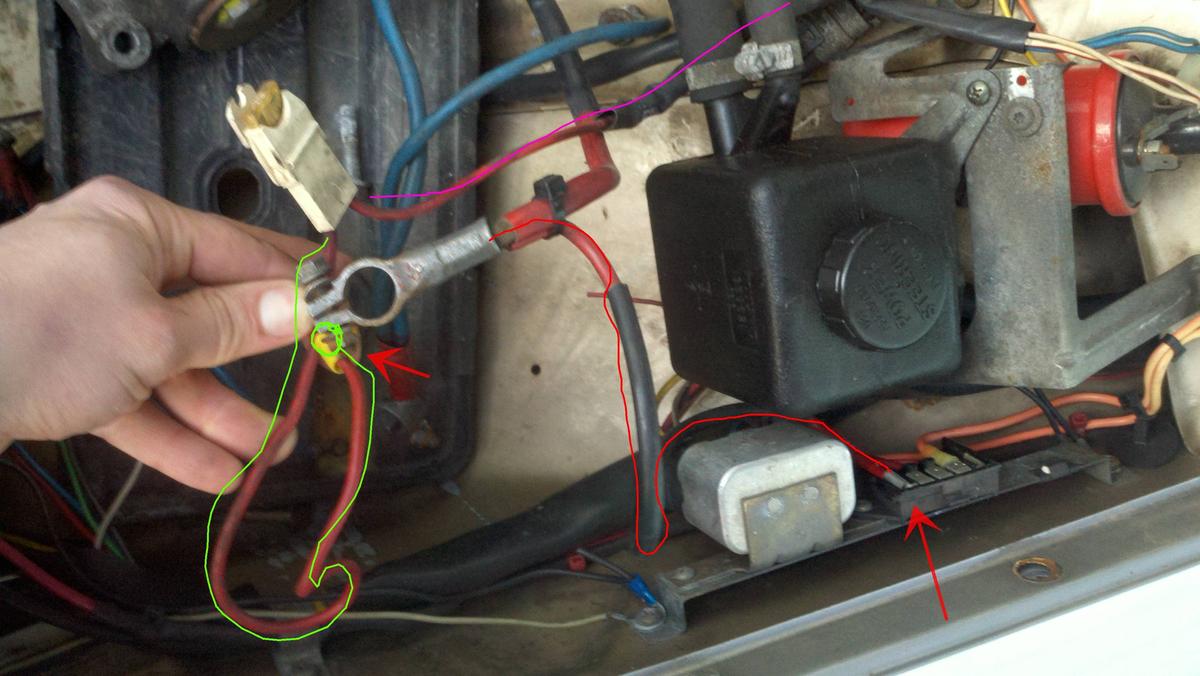
but many people replace these when they disintegrate with other sorts of fuse holders, I generally use a marine fuse like...

the big red wire goes directly to the starter motor, and the medium red wire goes to the 'positive terminal' which is behind a flat black plastic box on the left fender wall, that positive terminal is where most everything else gets its power (are lots of red wires coming out of the bottom of said positive terminal). The positive terminal is where that red arrow points at the bottom right of the big pic above...
the starter motor solenoid circuit goes from that positive terminal to the ignition key, then a pink wire from the ignition key 'start' position goes to a 'park/neutral' safety switch on the automatic transmission (IF you have an automatic), and from there to the starter solenoid.
there should be a wire attached to the battery positive terminal that has inline blade fuse holder nearby, this the power to the entire fuel injection system. the stock EFI fuse looks like the white thing just above the guys hand...
but many people replace these when they disintegrate with other sorts of fuse holders, I generally use a marine fuse like...
the big red wire goes directly to the starter motor, and the medium red wire goes to the 'positive terminal' which is behind a flat black plastic box on the left fender wall, that positive terminal is where most everything else gets its power (are lots of red wires coming out of the bottom of said positive terminal). The positive terminal is where that red arrow points at the bottom right of the big pic above...
the starter motor solenoid circuit goes from that positive terminal to the ignition key, then a pink wire from the ignition key 'start' position goes to a 'park/neutral' safety switch on the automatic transmission (IF you have an automatic), and from there to the starter solenoid.
no mo volvo
Joined: Oct 2010
Posts: 11,289
Likes: 109
From: 37 North on the left coast
the wiring diagram for a 1991 240 shows all power to the HVAC comes either off the positive terminal, or via the ignition switch, there's no connections directly off the battery.

Senior Member
Joined: Jan 2006
Posts: 1,797
Likes: 52
It looks to me that the wire he is holding is not connected to the battery. It looks to me he is holding a black wire: one end bare (not connected) where the other end goes to a round plug-in connector with a green wire coming out that goes into the wiring harness.
Last edited by act1292; Dec 23, 2015 at 09:59 PM.
Thread Starter
|
Junior Member
Joined: Dec 2012
Posts: 15
Likes: 0
Park Neutral mechanism responsible for no starter from ignition
Thank you Pierce and Act1292. It was park neutral mechanism responsible for no starter from ignition switch and I got that fixed. Now I test and there is a spark.
It is now for me to test the fuel system, hopefully just that fuel-pump relay. What is the best way to test the relay? I know how to test the fuel pumps by bypassing the pumps and they are fine.
Regarding the battery lines, I don't have a line connecting from the battery + terminal to a 25 ohm fuse, and then going into a harness and onward to the EFI (as I understand is the conventional system by design). My 1990 has this fuse, is it possible that it is gone with the 1991 design? I can't figure how it would disappear entirely. I wish I knew where that wire went to, where is the EFI connection associated with this line? It seems likely my fuel system isn't getting the required power. If I pull that 25ohm fuse on my 1990 the pumps will still engage and the engine will get a gas supply when I crank the engine, but still it won't run. I learned this from a corroded 25ohm fuse in another car. I wonder if this is the problem I am having.
It is now for me to test the fuel system, hopefully just that fuel-pump relay. What is the best way to test the relay? I know how to test the fuel pumps by bypassing the pumps and they are fine.
Regarding the battery lines, I don't have a line connecting from the battery + terminal to a 25 ohm fuse, and then going into a harness and onward to the EFI (as I understand is the conventional system by design). My 1990 has this fuse, is it possible that it is gone with the 1991 design? I can't figure how it would disappear entirely. I wish I knew where that wire went to, where is the EFI connection associated with this line? It seems likely my fuel system isn't getting the required power. If I pull that 25ohm fuse on my 1990 the pumps will still engage and the engine will get a gas supply when I crank the engine, but still it won't run. I learned this from a corroded 25ohm fuse in another car. I wonder if this is the problem I am having.
Last edited by mdesswein; Dec 25, 2015 at 05:21 PM. Reason: hope to get rid of ad
no mo volvo
Joined: Oct 2010
Posts: 11,289
Likes: 109
From: 37 North on the left coast
Probably the best test is to pull the fuel pump relay and jumper its socket, and try starting the car, if it runs, its probably a bad relay. replace with Stribel or Volvo. the relay has two outputs, one powers the ECU and stuff, and the other powers the fuel pumps and stuff.
jumper pins 30 to 87 and 87b (or it might be 87/1 and 87/2, depends on the labeling). if they are numbered 1-6, then its pin 3 to pin 1 and 5.
jumper pins 30 to 87 and 87b (or it might be 87/1 and 87/2, depends on the labeling). if they are numbered 1-6, then its pin 3 to pin 1 and 5.
Thread Starter
|
Junior Member
Joined: Dec 2012
Posts: 15
Likes: 0
replaced fuel pump relay but no fire at all
I replaced the fuel pump relay with the one that I have on a running 1986. The 1991 still doesn't fire. It sparks and I can smell gas like it's flooded. I turn it over for about fifteen seconds maybe a few times and not even a slight sputter.
The only other time I ever had this sort of thing happen is when there was corrosion on that fuse from the positive battery terminal. Of my four Volvos, one 1986, two 1990s, and this now problematic 1991, this is the only vehicle without the fuse and the thick wire from the positive terminal.
What would you suggest I check next? I have the convenience of another running Volvo, although the ones with the similar computers are parked in the country during the winter. But the 1990 has the same computer as the 1991 and I drove out there to look at the wires and they are nearly the same as the 1986.
The only other time I ever had this sort of thing happen is when there was corrosion on that fuse from the positive battery terminal. Of my four Volvos, one 1986, two 1990s, and this now problematic 1991, this is the only vehicle without the fuse and the thick wire from the positive terminal.
What would you suggest I check next? I have the convenience of another running Volvo, although the ones with the similar computers are parked in the country during the winter. But the 1990 has the same computer as the 1991 and I drove out there to look at the wires and they are nearly the same as the 1986.
no mo volvo
Joined: Oct 2010
Posts: 11,289
Likes: 109
From: 37 North on the left coast
yeah, the harness differences between LH 2.2 and LH 2.4 were fairly minimal. 2.4 uses a crank position sensor while 2.2 used a hall sensor in the distributor. they both used the same dual fuel pump/injection relay.
on LH 2.4, the fuel pumps should run for a second when you turn on the ignition then go out. crank the car and they should immediately start running againg, stopping about a second after the engine stops turning over.
If you have good spark, and the fuel pumps are running, there's still a few common failure modes. for instance, the fuel pressure regulator diagphram can fail, and it spews fuel out the vacuum line.
on LH 2.4, the fuel pumps should run for a second when you turn on the ignition then go out. crank the car and they should immediately start running againg, stopping about a second after the engine stops turning over.
If you have good spark, and the fuel pumps are running, there's still a few common failure modes. for instance, the fuel pressure regulator diagphram can fail, and it spews fuel out the vacuum line.
Thread Starter
|
Junior Member
Joined: Dec 2012
Posts: 15
Likes: 0
I did notice gas coming out the vacuum line
Please tell me more about the failing fuel pump regulator diagphram. I had the fuel pressure regulator line disconnected from the port near or within the intake and could see gas burping out of that port. Not a lot, but I did explicitly mark it as unusual and then plugged the line back in.
Thread Starter
|
Junior Member
Joined: Dec 2012
Posts: 15
Likes: 0
The FPR seems fine. There is no smell or evidence of gas. That burp occurred at the manifold yesterday, not at the FPR. I imagine the car was flooded. It's getting gas and spark. I wonder if sufficient spark? Anyway, I can clearly see the spark. And I checked the diagnostic computer for RPM sensor reading, and it is fine. The crank sensor I didn't test, I don't know how to do so. I disconnected the fuel line to verify gas upon crank and all fine. Of course, I swapped the fuel relay yesterday with a running car; both relays seem fine.
Thread Starter
|
Junior Member
Joined: Dec 2012
Posts: 15
Likes: 0
OK, I took off the distributor cap and turned the crank to tdc, and it's on piston 2. I don't know how this happened. I again removed the timing belt covers and the timing marks are perfect. When I get the marks lined up THEN I'm on piston number one, but the crank is not at tdc when the crank timing mark is lined up to it's indicator.
Thread Starter
|
Junior Member
Joined: Dec 2012
Posts: 15
Likes: 0
Please verify TDC status: the piston one should be at the top of cylinder one, crank timing mark at zero, and distributor rotor at cylinder one. Correct? I may have had the crank at the bottom of cylinder one and not at the top? I'm pretty confused right now.
no mo volvo
Joined: Oct 2010
Posts: 11,289
Likes: 109
From: 37 North on the left coast
TDC == Top Dead Center. if the crank is at TDC, then cyl 1 should be at the very top. note the distributor goes around once for 2 turns of the crank, so you can have the crank at TDC and the distributor can be pointing 180 degrees opposite, a full turn of the crank should rectify that.
do not rely on any marks on the harmonic pulley, as that can spin relative to the crank. you have to use the marks on the actual timing belt pulley

do not rely on any marks on the harmonic pulley, as that can spin relative to the crank. you have to use the marks on the actual timing belt pulley