


New to this forum


 New to this forum
Hi all. My name is Gary andI have an '85 245GL that I've owned for about 6years. I've been searching the forum but cannot find my particular concern addressed.
This car has an occasional crank, no start condition. It usually is resolved by unplugging what I think is the ignition amplifier; cleaning the terminals and plugging it back in. I recently replaced both battery cables only to find the situation has returned and does not appear to rectifiy with this proceedure. Any advice would be appreciated.
Thanks, Gary
This car has an occasional crank, no start condition. It usually is resolved by unplugging what I think is the ignition amplifier; cleaning the terminals and plugging it back in. I recently replaced both battery cables only to find the situation has returned and does not appear to rectifiy with this proceedure. Any advice would be appreciated.
Thanks, Gary

So it cranks, but does not start, sounds like no fuel. When this happened to me, I moved the fuel pump fuses around (fuse #4, 5 on yours maybe, and 6) and it gave it fuel. When it would not start for you and you messed with the ignition and such, you got rid of that static on the fuses probably.

But you replaced the battery cables and it worked, so I still think it is electrical. Does the pump make noise when you turn the key before starting it?
Last edited by Burn Stains; Jun 19, 2011 at 05:35 PM.

no mo volvo
Joined: Oct 2010
Posts: 11,289
Likes: 109
From: 37 North on the left coast
fuses don't hold 'static', although they can get corroded.
there's two main possibilities for a crank-no-start.... no spark or no fuel. after trying to start, pull a spark plug. if its wet, you probably have a spark problem. if its dry, you may have a fuel problem.
cutting the potential problem space in half greatly aids in problem determination.
there's two main possibilities for a crank-no-start.... no spark or no fuel. after trying to start, pull a spark plug. if its wet, you probably have a spark problem. if its dry, you may have a fuel problem.
cutting the potential problem space in half greatly aids in problem determination.
no mo volvo
Joined: Oct 2010
Posts: 11,289
Likes: 109
From: 37 North on the left coast
um, "static electricity" refers to a particular sort of charge that can be accumulated on non-conductive surfaces, the kind that gives you little sparks after you walk across a wool carpet on a dry day. electricity in circuitry that's not "moving" (more accurately, an open circuit, so no current flow) is known as 'potential', and its something very different, DC voltage without current.
[I've got an electronics engineering background and a strong interest in physical sciences]
[I've got an electronics engineering background and a strong interest in physical sciences]
They taught me all wrong in school. DC voltage without current? It's so simple! I won't argue with a degree, I knew static was not completely correct, I just remember static = electricity that is not moving.

Junior Member
Joined: Apr 2011
Posts: 14
Likes: 0
From: Roseville, CA
Current is measured in amps but is often called "amperage"
Distance is measured in miles but is often called "mileage"
What's the acreage of your ranch? You mean area?
Anyway Gary, since you have spark, check for lack of fuel, or excess fuel. Excess fuel will show as a wet sprk plug. If it is dry, check fuses and ground connections for fuel pump first.
no mo volvo
Joined: Oct 2010
Posts: 11,289
Likes: 109
From: 37 North on the left coast
yeah, Potential is used more in physics than in electronics as engineers tend to be more practical, while scientists tend to be more theoretical. When I was in school, we still used "E" (properly, ℰ if you have UTF8 support) for voltage in formulas (and I for current). Ohm's law was E=I*R. IIRC, E stood for emf or electromotive force. Now days I almost always see it as V=A*R (yes, R not O for Ohms, ah well).
a wise man once said...
"In theory, practice is the same as theory. In practice, its not."
a wise man once said...
"In theory, practice is the same as theory. In practice, its not."
Yeah, they tried to make it simple like that, but most kids still don't get it. It's labeled so easily now! Just plug in the numbers, but that is still too much work...
Pulled a plug and cranked the engine and had spark. Plug is dry. Both fuel related fuses are good. I can't hear a fuel pump. but, can't say that I ever did with this car. According the MITCHELL there are 2 fuel pumps, correct?
The car never restarted after installing new cables. Have rechecked all the connections and they appear good.
The car never restarted after installing new cables. Have rechecked all the connections and they appear good.
no mo volvo
Joined: Oct 2010
Posts: 11,289
Likes: 109
From: 37 North on the left coast
I think I'd be checking that the 'main' relay which powers the fuel ECU and stuff is working.
your 85 240 should be LH2.2, which is very similar but not 100% identical to the earlier 740 models, I'd go down this list of things,
Engine Tune and Performance
note you do not have the 'radio suppression relay' mentioned there, the main relay does that job. otherwise, pretty much identical to the earlier 740s.
brute force method of verifying the fuel pumps are working: disconnect the hose that comes out of the back side of the fuel pressure regulator, this is the return line to the gas tank, and connect a temporary hose in its place, running into a empty gasoline container. turn the key on and crank for 5 seconds, key off. you should have about a half to whole pint of gas in that container now. if you do, i'd be looking at the injectors and controller circuitry. if you don't, i'd be looking at the fuel pumps.
there's a low pressure fuel pump in the gas tank, and a high pressure fuel pump under the car, forward of the gas tank. the fuel filter is next to the high pressure pump. both pumps need to work for proper running (cars will run somewhat erratically with the tank pump out, they won't run at all with the main/pressure pump out)
first rule of wrenching, if you did something and something broke afterwards, its almost always the last thing you did. If you channged the battery cables, I'd be checking that there is +12V to ground by putting a volt meter on various 'red' wires and measuring to engine ground (a valve cover bolt or whatever).
your 85 240 should be LH2.2, which is very similar but not 100% identical to the earlier 740 models, I'd go down this list of things,
Engine Tune and Performance
note you do not have the 'radio suppression relay' mentioned there, the main relay does that job. otherwise, pretty much identical to the earlier 740s.
brute force method of verifying the fuel pumps are working: disconnect the hose that comes out of the back side of the fuel pressure regulator, this is the return line to the gas tank, and connect a temporary hose in its place, running into a empty gasoline container. turn the key on and crank for 5 seconds, key off. you should have about a half to whole pint of gas in that container now. if you do, i'd be looking at the injectors and controller circuitry. if you don't, i'd be looking at the fuel pumps.
there's a low pressure fuel pump in the gas tank, and a high pressure fuel pump under the car, forward of the gas tank. the fuel filter is next to the high pressure pump. both pumps need to work for proper running (cars will run somewhat erratically with the tank pump out, they won't run at all with the main/pressure pump out)
first rule of wrenching, if you did something and something broke afterwards, its almost always the last thing you did. If you channged the battery cables, I'd be checking that there is +12V to ground by putting a volt meter on various 'red' wires and measuring to engine ground (a valve cover bolt or whatever).
I would just do what this guy did this to check the fuel pumps, might be a little easier and less messy.
To test the pump itself, plus the sender wiring, apply battery power (in this example, from fuse #6) to the load side of the tank pump fuse. This is fuse #4 in 85-93 models, or fuse #5 on the earlier cars or 85 Turbo. Beginning in 89, the oxygen sensor heater is also powered here. If the fuse is removed, you’ll power up the tank pump on the right-hand terminal, and the main pump on the left. Test the pump a number of times to be sure it starts with each try, and the brushes don’t wind up in a bad spot on the commutator. Feed pumps in 78 and earlier models are not separately fused.
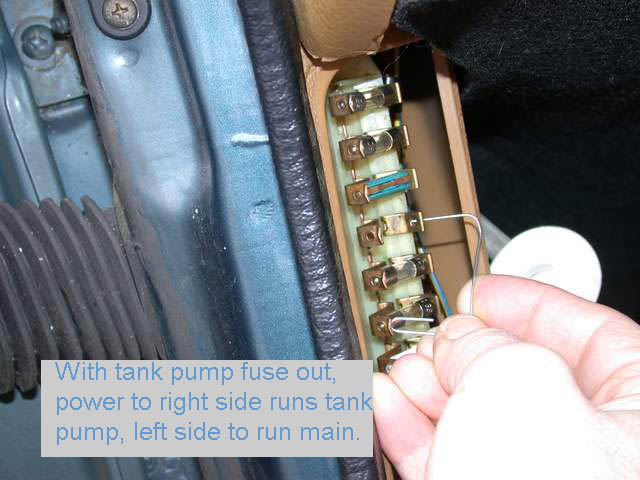
BTW: credit goes to http://cleanflametrap.com/ for the above
To test the pump itself, plus the sender wiring, apply battery power (in this example, from fuse #6) to the load side of the tank pump fuse. This is fuse #4 in 85-93 models, or fuse #5 on the earlier cars or 85 Turbo. Beginning in 89, the oxygen sensor heater is also powered here. If the fuse is removed, you’ll power up the tank pump on the right-hand terminal, and the main pump on the left. Test the pump a number of times to be sure it starts with each try, and the brushes don’t wind up in a bad spot on the commutator. Feed pumps in 78 and earlier models are not separately fused.
BTW: credit goes to http://cleanflametrap.com/ for the above
Last edited by Burn Stains; Jun 20, 2011 at 01:37 PM. Reason: giving credit
Tried this
I just tried this procedure since it seemed so simple and I heard a fuel pump run. I then turned the car over with the key, no start. So Back to wrench 101, I retraced everything in the battery cable replacement and to my embarassment, found the lead to the underhood fuse not connected to the positive cable. I want to thank everyone here for their expert guidance and apologize for the time you took for my bonehead error. Nothing ever has gone really wrong with this car, so, I'm a bit green on repairing it.
I would just do what this guy did this to check the fuel pumps, might be a little easier and less messy.
To test the pump itself, plus the sender wiring, apply battery power (in this example, from fuse #6) to the load side of the tank pump fuse. This is fuse #4 in 85-93 models, or fuse #5 on the earlier cars or 85 Turbo. Beginning in 89, the oxygen sensor heater is also powered here. If the fuse is removed, you’ll power up the tank pump on the right-hand terminal, and the main pump on the left. Test the pump a number of times to be sure it starts with each try, and the brushes don’t wind up in a bad spot on the commutator. Feed pumps in 78 and earlier models are not separately fused.
BTW: credit goes to Volvo 240 Heater AC Blower Fan Motor Replacement for the above
To test the pump itself, plus the sender wiring, apply battery power (in this example, from fuse #6) to the load side of the tank pump fuse. This is fuse #4 in 85-93 models, or fuse #5 on the earlier cars or 85 Turbo. Beginning in 89, the oxygen sensor heater is also powered here. If the fuse is removed, you’ll power up the tank pump on the right-hand terminal, and the main pump on the left. Test the pump a number of times to be sure it starts with each try, and the brushes don’t wind up in a bad spot on the commutator. Feed pumps in 78 and earlier models are not separately fused.
BTW: credit goes to Volvo 240 Heater AC Blower Fan Motor Replacement for the above
Last edited by GaryMc; Jun 21, 2011 at 12:27 PM.
