


lazy s60r


Thread Starter
|
Junior Member
Joined: Oct 2013
Posts: 5
Likes: 0
 lazy s60r
Good day folks, I need Help.
I have got a lazy 2004 s60R. Ever since I bought he car it never had "WOW " performance. During he first service a mechanic claim it was fine, at the second service he had a deeper look into he problem and said the turbo vacuum hoses were swapped??? the performance increased significantly. But now it seems to have gradually gone back were it was. My s60 2.4T will outrun it by far. No engine light come on. except for a bit of hunting when idle-ing and cold, the car runs smooth.
How would I know when The turbo has handed in its resignation.
Looking forward to some advice.
thankx
I have got a lazy 2004 s60R. Ever since I bought he car it never had "WOW " performance. During he first service a mechanic claim it was fine, at the second service he had a deeper look into he problem and said the turbo vacuum hoses were swapped??? the performance increased significantly. But now it seems to have gradually gone back were it was. My s60 2.4T will outrun it by far. No engine light come on. except for a bit of hunting when idle-ing and cold, the car runs smooth.
How would I know when The turbo has handed in its resignation.
Looking forward to some advice.
thankx

Junior Member
Joined: Jan 2009
Posts: 15
Likes: 0

I am far from a Volvo expert but when a turbo dies it usually lets you know in a obvious way. Heavy oil in the intake track or oil smoke from the exhaust. Loud whine or sounds from the wheels contacting the housings. If you can take the intake tube off and look into the turbo. Check for nicks or damage to the wheel and feel for play in the shaft allowing it to move in and out more than just a little. See that it spins freely. Your lack of performance could be a waste gate issue or loose vac hose or a leaking coupling on one of the tubes from turbo to intake.

Senior Member
Joined: Jun 2009
Posts: 748
Likes: 1
From: Utah (for now)
A boost gauge would tell you what the turbo is actually doing. You could borrow a friend's pressure gauge and splice it in to see. I few simple items to check would be the PWM valve for the boost control. The waste gate it set to 4 - 5 psi. If the valve fails, you are stuck at that, instead of getting to a computer controlled 14.2 psi. That's less than the low pressure turbos in "lesser" Volvos. Another possibility is the waste gate actuator lock nut came loose and the waste gate has been backing off and it's been acting more and more like it's weak because all he exhaust can now bypass the turbine. That actually seems very likely to me. The other idea I have is the compressor bypass valve could be leaking. It's that funny round thing held down by 3 allen-head screws. In general a turbo will still develop boost until after it's leaking lots of oil, and making bad noises.
If none of that makes sense and you want some write ups on how that is done, I can make one and post some pics. I actually have a dead turbo out of my S60R I can use for pictures.
If none of that makes sense and you want some write ups on how that is done, I can make one and post some pics. I actually have a dead turbo out of my S60R I can use for pictures.
Thread Starter
|
Junior Member
Joined: Oct 2013
Posts: 5
Likes: 0
Thank you for all the replies. Check my replies in blue.
A boost gauge would tell you what the turbo is actually doing. You could borrow a friend's pressure gauge and splice it in to see.
Excuse the ignorance is there no quick coupling that i can connect a standard 1/4 '' pressure gauge.
I few simple items to check would be the PWM valve for the boost control.
Where do I find and check this beast.
The waste gate it set to 4 - 5 psi. If the valve fails, you are stuck at that, instead of getting to a computer controlled 14.2 psi. That's less than the low pressure turbos in "lesser" Volvos. Another possibility is the waste gate actuator lock nut came loose and the waste gate has been backing off and it's been acting more and more like it's weak because all he exhaust can now bypass the turbine. That actually seems very likely to me.
To be checked.
The other idea I have is the compressor bypass valve could be leaking. It's that funny round thing held down by 3 allen-head screws. In general a turbo will still develop boost until after it's leaking lots of oil, and making bad noises.
No noises, will check if oil is accumulating in the induction system.( as per elimont's suggestion)
If none of that makes sense and you want some write on how that is done, I can make one and post some pics. I actually have a dead turbo out of my S60R I can use for pictures.[/QUOTE]
Thanks, I will need help with this.
Looking at at the flood of replies to this post (both of them) I gather that this question is is a cut above the norm. thanks for the advice.
A boost gauge would tell you what the turbo is actually doing. You could borrow a friend's pressure gauge and splice it in to see.
Excuse the ignorance is there no quick coupling that i can connect a standard 1/4 '' pressure gauge.
I few simple items to check would be the PWM valve for the boost control.
Where do I find and check this beast.
The waste gate it set to 4 - 5 psi. If the valve fails, you are stuck at that, instead of getting to a computer controlled 14.2 psi. That's less than the low pressure turbos in "lesser" Volvos. Another possibility is the waste gate actuator lock nut came loose and the waste gate has been backing off and it's been acting more and more like it's weak because all he exhaust can now bypass the turbine. That actually seems very likely to me.
To be checked.
The other idea I have is the compressor bypass valve could be leaking. It's that funny round thing held down by 3 allen-head screws. In general a turbo will still develop boost until after it's leaking lots of oil, and making bad noises.
No noises, will check if oil is accumulating in the induction system.( as per elimont's suggestion)
If none of that makes sense and you want some write on how that is done, I can make one and post some pics. I actually have a dead turbo out of my S60R I can use for pictures.[/QUOTE]
Thanks, I will need help with this.
Looking at at the flood of replies to this post (both of them) I gather that this question is is a cut above the norm. thanks for the advice.
Senior Member
Joined: Jun 2009
Posts: 748
Likes: 1
From: Utah (for now)
Sorry, I've been pretty busy.
So I'm not sure how much you know about turbochargers in general, but I'll give you a rundown, and if you already know it, it may benefit someone else trying to learn how a turbocharger works.
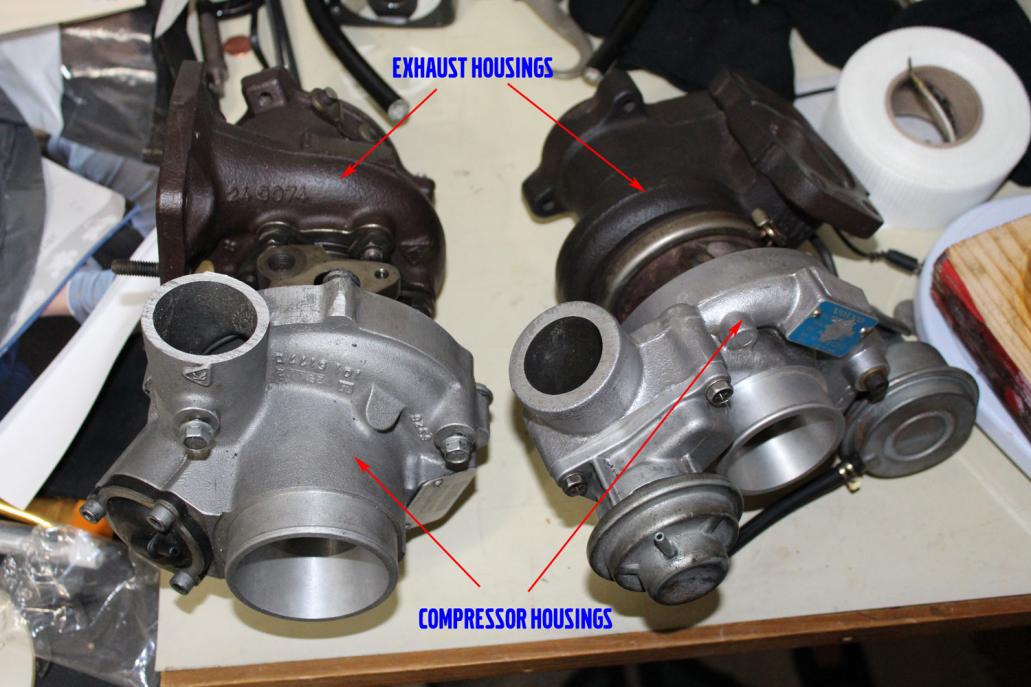
A turbocharger come from the word turbosupercharger. Turbo means turbine powered. Super means over. Charge refers to the fuel air mixture. So it's a turbine powered thing that shoves more charge into the engine. The turbine sits in the path of the exhaust and is rotated by escaping exhaust gasses. It connects to a compressor (like the compressors used on a jet engine) through a shaft. The compressor is an impeller that sucks air in the front and blows it out the radius. The compressor housing collects it and it exits the housing more dense. More dense air means more fuel can be added. That all means more power. It's pretty simple.
Now a turbo can go crazy and cause damage to and engine or itself so they are controlled by a few things. This is probably the most interesting information to you. The first is when you close the throttle plate under boost (like when shifting). The turbo is spinning (like at 150 to 200k RPM). The throttle plate blocks off the system suddenly and you get a massive pressure spike that forces the air backwards through the compressor wheel. I can stop it dead, reverse the turbo and or damage the bearings from the shock load. The solution is to let the turbo freewheel. The high vacuum in the intake manifold actuates a valve that will bleed the compressed air from the turbo either to atmosphere or feed it back into the compressor. On modded car it is common to hear a hiss between shifts because of this. Most cars will vent to the atmosphere (blow off valve), but our Volvos recirculate it (bypass valve).
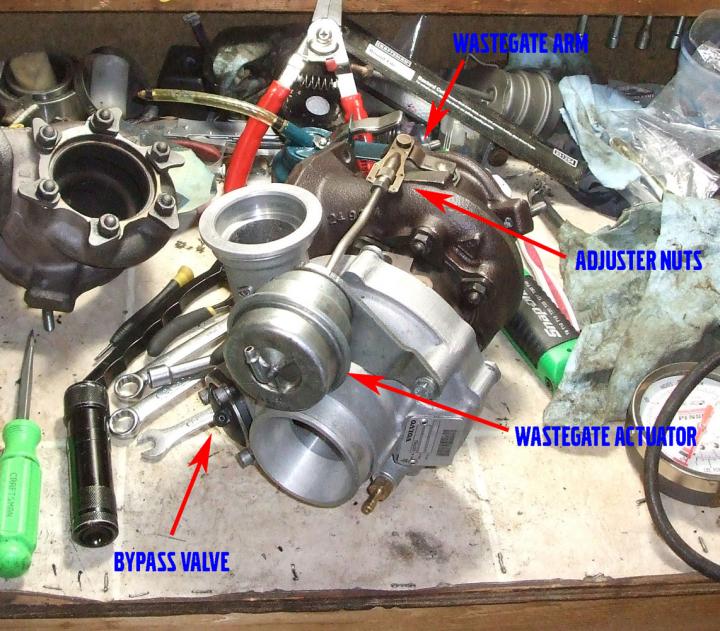
So if the bypass valve was stuck open it would make developing boost very tough. It's help shut by a spring. You can see it labeled in one of the pictures. I know that they are prone to leak in a modified R, so I think it's one of the later things that I'd check.
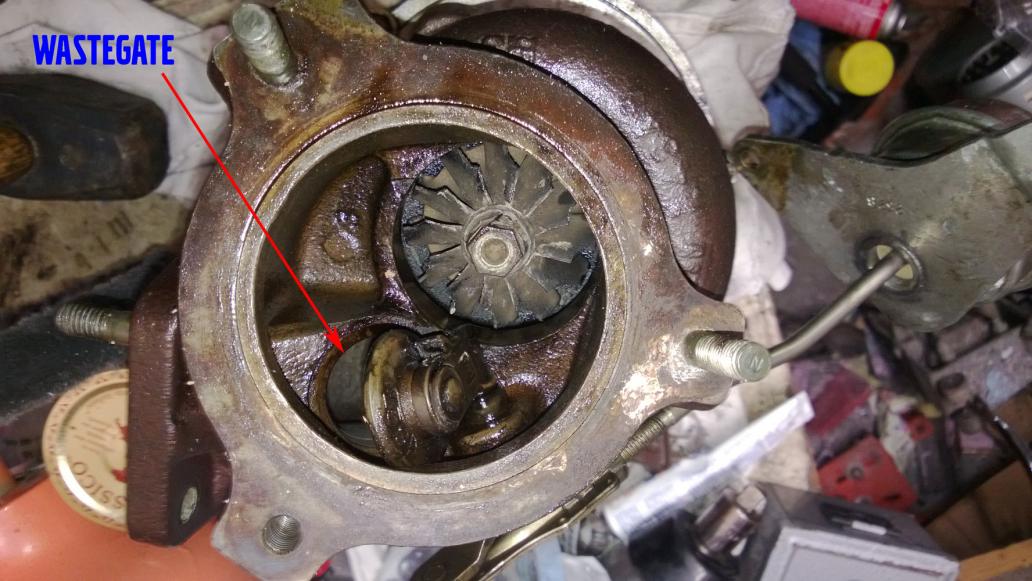
The other regulator system is the wastegate. I think it's much more suspect. Here's the run down on how it works. Exhaust gasses pass through the turbine to spin the turbocharger, but you can regulate how much by having a bypass around the turbine. How the basic system works is the pressure developed on the compressor side pushes on the wastegate actuator. It is a spring and diaphragm thing with a push rod. When a certain pressure is developed by the compressor that pressure will exert enough force on the diaphragm and spring to move the actuator and push rod. That connects to the wastegate arm and opens the wastegate. It allows a certain pressure to develop and let's it develop no further. The wastegate can be adjusted by changing the length of the push rod. a shorter rod means more boost. A longer rod will eventually get to the point where the gate opens and the wastegate is just wasting the exhaust and not developing boost. My friend's car had the push rod arm fall off so it would not hold the gate shut and developed no boost. This is what I am thinking may have happened to you. I think that the lock nut on the push rod came loose and the push rod adjustment is so loose now you are not getting any boost. Setting the wastegate properly is super important! Too tight and you can harm your engine!
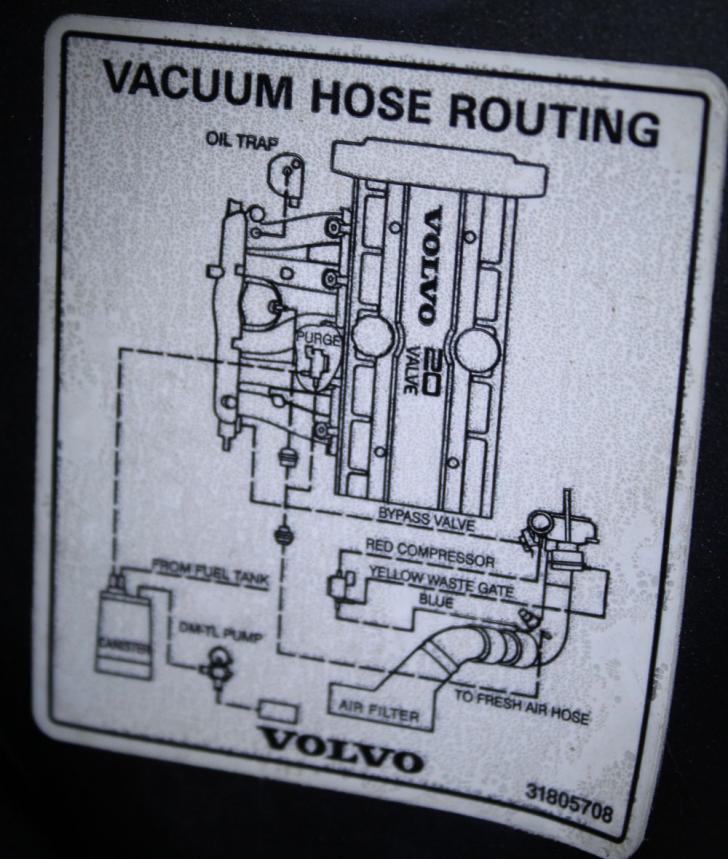
My 89 740 is set to 7 PSI stock (at & PSI the wastegate starts to open). On new Volvos the wastegate is set to open around 4.5 PSI. Now the real trick here is the newer engines boost to much higher pressures. How do they do that with the wastegate actuator set to 4.5 PSI? They use a computer controlled valve, a pulse width modulator (PWM). It splices into the pressure line that goes from the compressor housing to the wastegate actuator. A third line goes to the fresh air pipe just before the turbo inlet. It's job is to bleed off pressure to fool the wastegate actuator into thinking that the pressure in the compressor housing is less than what it really is. The computer has it's own sensor and can monitor and adjust the pressure at it's own will (up to 14.2 PSI stock). It can also back it off if the computer detects misfires and pinging. The hoses are labeled on a sticker on the hood for vacuum routing, I'll include a picture. They should be color coded on the ends and the shape of the PWM valve in the picture can help you check them. It's my guess that the mechanic said these were mixed up. I think the PWM is under the air filter box, mine was just floating around down there when I bought the car, so I'm not sure sure where it's mounted.
So you may want to find a 0-15 or 30 PSI gauge that you can hook up the the car for a couple purposes. First, to check the boost pressure when rolling down the road and then use it to set the wastegate. The smaller the scale on the gauge, the more accurate it will be. You'll need something to pump up the wastegate actuator and read the pressure. Also there is an exhaust shield over the turbine housing that covers up the wastegate actuator push rod and the arm. I would also remove the large bar that goes over the back of the engine and bolts to the engine. You just need to remove the line going to the wastegate actuator and pipe in your pressure there.
The PWM is this: Volvo Boost Pressure Valve - Pierburg 30670449 | FCP Euro
You can just pull it out, connected the leads to 12V and see if it clicks on and off when you connect and disconnect it. This valve switches on and off several times a second, so it must work well. Also in the off position it should let air flow freely through the lines that go from red to yellow lines. When on, it should also allow air to flow through the blue line. You can refer the diagram to see this. If it's not switching you need a new one and that will cause you only to get a 4.5 PSI boost and make the car seem weaker than base model turbo Volvo's. Also if it's unplugged You'll get the same effect, but it should light the check engine light.
Here's where I spliced in for my turbo gauge:
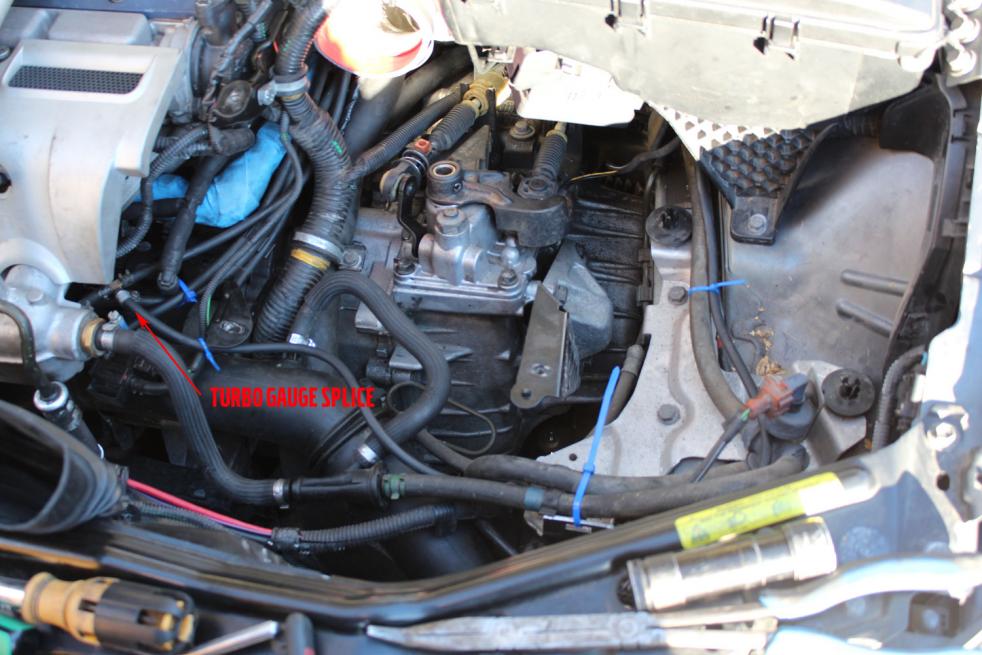
Hopefully this gives a full enough picture of the system and a few ideas that you can nail this problem and start enjoying the true meaning of an R. I do Also recommend making sure that your turbo is in good shape. How many miles are on the car?
So I'm not sure how much you know about turbochargers in general, but I'll give you a rundown, and if you already know it, it may benefit someone else trying to learn how a turbocharger works.
A turbocharger come from the word turbosupercharger. Turbo means turbine powered. Super means over. Charge refers to the fuel air mixture. So it's a turbine powered thing that shoves more charge into the engine. The turbine sits in the path of the exhaust and is rotated by escaping exhaust gasses. It connects to a compressor (like the compressors used on a jet engine) through a shaft. The compressor is an impeller that sucks air in the front and blows it out the radius. The compressor housing collects it and it exits the housing more dense. More dense air means more fuel can be added. That all means more power. It's pretty simple.
Now a turbo can go crazy and cause damage to and engine or itself so they are controlled by a few things. This is probably the most interesting information to you. The first is when you close the throttle plate under boost (like when shifting). The turbo is spinning (like at 150 to 200k RPM). The throttle plate blocks off the system suddenly and you get a massive pressure spike that forces the air backwards through the compressor wheel. I can stop it dead, reverse the turbo and or damage the bearings from the shock load. The solution is to let the turbo freewheel. The high vacuum in the intake manifold actuates a valve that will bleed the compressed air from the turbo either to atmosphere or feed it back into the compressor. On modded car it is common to hear a hiss between shifts because of this. Most cars will vent to the atmosphere (blow off valve), but our Volvos recirculate it (bypass valve).
So if the bypass valve was stuck open it would make developing boost very tough. It's help shut by a spring. You can see it labeled in one of the pictures. I know that they are prone to leak in a modified R, so I think it's one of the later things that I'd check.
The other regulator system is the wastegate. I think it's much more suspect. Here's the run down on how it works. Exhaust gasses pass through the turbine to spin the turbocharger, but you can regulate how much by having a bypass around the turbine. How the basic system works is the pressure developed on the compressor side pushes on the wastegate actuator. It is a spring and diaphragm thing with a push rod. When a certain pressure is developed by the compressor that pressure will exert enough force on the diaphragm and spring to move the actuator and push rod. That connects to the wastegate arm and opens the wastegate. It allows a certain pressure to develop and let's it develop no further. The wastegate can be adjusted by changing the length of the push rod. a shorter rod means more boost. A longer rod will eventually get to the point where the gate opens and the wastegate is just wasting the exhaust and not developing boost. My friend's car had the push rod arm fall off so it would not hold the gate shut and developed no boost. This is what I am thinking may have happened to you. I think that the lock nut on the push rod came loose and the push rod adjustment is so loose now you are not getting any boost. Setting the wastegate properly is super important! Too tight and you can harm your engine!
My 89 740 is set to 7 PSI stock (at & PSI the wastegate starts to open). On new Volvos the wastegate is set to open around 4.5 PSI. Now the real trick here is the newer engines boost to much higher pressures. How do they do that with the wastegate actuator set to 4.5 PSI? They use a computer controlled valve, a pulse width modulator (PWM). It splices into the pressure line that goes from the compressor housing to the wastegate actuator. A third line goes to the fresh air pipe just before the turbo inlet. It's job is to bleed off pressure to fool the wastegate actuator into thinking that the pressure in the compressor housing is less than what it really is. The computer has it's own sensor and can monitor and adjust the pressure at it's own will (up to 14.2 PSI stock). It can also back it off if the computer detects misfires and pinging. The hoses are labeled on a sticker on the hood for vacuum routing, I'll include a picture. They should be color coded on the ends and the shape of the PWM valve in the picture can help you check them. It's my guess that the mechanic said these were mixed up. I think the PWM is under the air filter box, mine was just floating around down there when I bought the car, so I'm not sure sure where it's mounted.
So you may want to find a 0-15 or 30 PSI gauge that you can hook up the the car for a couple purposes. First, to check the boost pressure when rolling down the road and then use it to set the wastegate. The smaller the scale on the gauge, the more accurate it will be. You'll need something to pump up the wastegate actuator and read the pressure. Also there is an exhaust shield over the turbine housing that covers up the wastegate actuator push rod and the arm. I would also remove the large bar that goes over the back of the engine and bolts to the engine. You just need to remove the line going to the wastegate actuator and pipe in your pressure there.
The PWM is this: Volvo Boost Pressure Valve - Pierburg 30670449 | FCP Euro
You can just pull it out, connected the leads to 12V and see if it clicks on and off when you connect and disconnect it. This valve switches on and off several times a second, so it must work well. Also in the off position it should let air flow freely through the lines that go from red to yellow lines. When on, it should also allow air to flow through the blue line. You can refer the diagram to see this. If it's not switching you need a new one and that will cause you only to get a 4.5 PSI boost and make the car seem weaker than base model turbo Volvo's. Also if it's unplugged You'll get the same effect, but it should light the check engine light.
Here's where I spliced in for my turbo gauge:
Hopefully this gives a full enough picture of the system and a few ideas that you can nail this problem and start enjoying the true meaning of an R. I do Also recommend making sure that your turbo is in good shape. How many miles are on the car?
Last edited by Titan Joe; Nov 16, 2013 at 01:31 PM.
Thread Starter
|
Junior Member
Joined: Oct 2013
Posts: 5
Likes: 0
Thank you for this elaborate explanation. It is always nice to know what is happening under the bonnet. When you know what's happening under the bonnet you actually look forward to solving the problem rather than fear the gremlens.
The car has got 180 000 km on it. The previous owner had the turbo repaired. It wound not surprise me if it was a bit of a botch job looking at the punch marks used to relocate all the components. On the positive side there is no noise and no smoke.
Thanks again for the effort you put in to this post it is much appreciated.
The car has got 180 000 km on it. The previous owner had the turbo repaired. It wound not surprise me if it was a bit of a botch job looking at the punch marks used to relocate all the components. On the positive side there is no noise and no smoke.
Thanks again for the effort you put in to this post it is much appreciated.


Thread
Thread Starter
Forum
Replies
Last Post
AzNick
General Volvo Chat
11
Mar 14, 2009 09:38 PM
