


battery cca question


Thread Starter
|
Senior Member
Joined: Jan 2009
Posts: 181
Likes: 0
 battery cca question
so im reading over my tech manual because the wife is insistant that our volvo is taking longer than usual to start up. ive humored her, tested it myself and it feels the same as it did last year when we purchased it.
anywho, in reading my tech manual, i show this for the battery:
BATTERY SPECIFICATIONS
CAUTION: When battery is disconnected, vehicles equipped with
computers may lose memory data. When battery power is
restored, driveability problems may exist on some vehicles.
These vehicles may require a relearn procedure. See COMPUTER
RELEARN PROCEDURES article in the GENERAL INFORMATION
section.
All models use a 520 A/100 Min. battery.
does this mean cold cranking amps or regular amps?
anywho, in reading my tech manual, i show this for the battery:
BATTERY SPECIFICATIONS
CAUTION: When battery is disconnected, vehicles equipped with
computers may lose memory data. When battery power is
restored, driveability problems may exist on some vehicles.
These vehicles may require a relearn procedure. See COMPUTER
RELEARN PROCEDURES article in the GENERAL INFORMATION
section.
All models use a 520 A/100 Min. battery.
does this mean cold cranking amps or regular amps?

Administrator
Joined: Mar 2009
Posts: 15,736
Likes: 36
From: Albuquerque, NM
I'm not sure about the cranking amps on the car, however, my car starts pretty slow. I think I have a bad battery, low cranking amps. When I go to start it, the volts drop to about 9, it turns over real slow at first, then picks up and kicks over. It takes about 4 seconds to start my car.
Some people are use to clicking the starter and the car starting, like in a Honda. While these I5 Volvo's usually take 3 seconds. The owners manual says to hold the key something like 5 seconds.
Some people are use to clicking the starter and the car starting, like in a Honda. While these I5 Volvo's usually take 3 seconds. The owners manual says to hold the key something like 5 seconds.
Thread Starter
|
Senior Member
Joined: Jan 2009
Posts: 181
Likes: 0
thats about how our volvo is. it cranks over kinda slow compared to my hondas and toyota, but once its going its great.
the wife may have been on to something though. i swapped the battery that was in the volvo (650cca/800amps) for the battery that was in the rav4 (500cca/625amps). the lag during startup was the same (1-2 seconds cranking) but once she kicked, the tach went up to 2k almost immediately. on the first battery, once she caught she wouldnt go above 1500 rpm tops on a good day. now, once she kicks, its like RAAAAAH IM READY in stead of alright fine lets go.
the wife may have been on to something though. i swapped the battery that was in the volvo (650cca/800amps) for the battery that was in the rav4 (500cca/625amps). the lag during startup was the same (1-2 seconds cranking) but once she kicked, the tach went up to 2k almost immediately. on the first battery, once she caught she wouldnt go above 1500 rpm tops on a good day. now, once she kicks, its like RAAAAAH IM READY in stead of alright fine lets go.

Super Moderator
Joined: May 2009
Posts: 2,702
Likes: 1
From: Rocklin, Ca
I noticed a big change in start up speed when my battery was replaced.
I also noticed it when I replaced my coil withe the MSD
I also noticed it when I changed the plugs.
This is all over the last two years but I specifically noticed changes when these items were replaced.
I think you could assume that a good tune up would help the car.
I also noticed it when I replaced my coil withe the MSD
I also noticed it when I changed the plugs.
This is all over the last two years but I specifically noticed changes when these items were replaced.
I think you could assume that a good tune up would help the car.
Thread Starter
|
Senior Member
Joined: Jan 2009
Posts: 181
Likes: 0
i have a full tune up planned for the car when income tax hits, as my mother in law gave us a rav4 that we thought we were going to have to pay her for.
well thats not accurate, im going to help her remodel her backyard.
anywho
things im planning on doing:
spark plug wires (plugs were changed a year ago with bosch oem)
left/right front tie rods
dizzy cap and rotor
ignition coil
motor and tranny mounts
new rear tires
rear main seal (i lose about a quart of oil every 5k oil change and it looks like its leaking)
battery (want to get an optima yellow / red top)
water pump
things that have been done already:
timing belt (done in 2009, car has approx. 25k miles since then)
radiator
radiator fan
thermostat (aftermarket, stant, 180F)
coolant system flush
MAF sensor
front axles
front struts
bilstein wagon springs
the one thing id really like to get handled is the ride quality when hitting a bump. despite having new struts in the front and springs all around, its still pretty loud and the bump feels like its hitting harder than it should.
im curious what could be causing this. thoughts are appreciated!
well thats not accurate, im going to help her remodel her backyard.
anywho
things im planning on doing:
spark plug wires (plugs were changed a year ago with bosch oem)
left/right front tie rods
dizzy cap and rotor
ignition coil
motor and tranny mounts
new rear tires
rear main seal (i lose about a quart of oil every 5k oil change and it looks like its leaking)
battery (want to get an optima yellow / red top)
water pump
things that have been done already:
timing belt (done in 2009, car has approx. 25k miles since then)
radiator
radiator fan
thermostat (aftermarket, stant, 180F)
coolant system flush
MAF sensor
front axles
front struts
bilstein wagon springs
the one thing id really like to get handled is the ride quality when hitting a bump. despite having new struts in the front and springs all around, its still pretty loud and the bump feels like its hitting harder than it should.
im curious what could be causing this. thoughts are appreciated!

Administrator
Joined: Mar 2010
Posts: 4,517
Likes: 12
From: Cape Coral, FL
Looks like it should be around 600 CCA min.
The battery shouldn't make much difference in how your vehicle starts unless the one you have is worn out and near the end of it's life. In that case it might be cranking at a slightly slower RPM. But the injectors and spark will still fire until about 9.6 volts and at that voltage you know you have a bad battery! I'm in Minnesota so I always try to put the biggest battery physically and CCA rating that I can make fit. I presently am running a 75/86 battery that is a dual terminal (stereo amps) at 720 CCA. It fits right in the tray.
You can drive your car down to any of the parts stores and they all should have a hand held load tester. That way you can have it tested while still in the car.
I updated to a MSD coil on a DIY mount and I can't say it starts any better but I'd like to think it does. I do know that it will have a hotter, stronger spark when I put my foot in it!
Besides your tune up toss in a can of injector cleaner too. If they are getting a bit gummed up it could cause a bit slower starting.
"the wife is insistant that our volvo is taking longer than usual to start up"
But in the end it might just be easier to show her the new battery under the hood. Been there, had to do that no matter what I said or showed someone. It's worse when you're trying to save someone money and they just won't have it. BUT .... it's even worse if they listen to you and then anything goes worng !!
The battery shouldn't make much difference in how your vehicle starts unless the one you have is worn out and near the end of it's life. In that case it might be cranking at a slightly slower RPM. But the injectors and spark will still fire until about 9.6 volts and at that voltage you know you have a bad battery! I'm in Minnesota so I always try to put the biggest battery physically and CCA rating that I can make fit. I presently am running a 75/86 battery that is a dual terminal (stereo amps) at 720 CCA. It fits right in the tray.
You can drive your car down to any of the parts stores and they all should have a hand held load tester. That way you can have it tested while still in the car.
I updated to a MSD coil on a DIY mount and I can't say it starts any better but I'd like to think it does. I do know that it will have a hotter, stronger spark when I put my foot in it!
Besides your tune up toss in a can of injector cleaner too. If they are getting a bit gummed up it could cause a bit slower starting.
"the wife is insistant that our volvo is taking longer than usual to start up"
But in the end it might just be easier to show her the new battery under the hood. Been there, had to do that no matter what I said or showed someone. It's worse when you're trying to save someone money and they just won't have it. BUT .... it's even worse if they listen to you and then anything goes worng !!
Last edited by Kiss4aFrog; Oct 19, 2011 at 01:40 PM.
Thread Starter
|
Senior Member
Joined: Jan 2009
Posts: 181
Likes: 0
i was thinking about doing an injector cleaning before i go through the tune up in february. is there a specific brand you recommend, or have used? i try and gas up with chevron w/ techron gas all the time, but in a pinch ill go to the texaco down the road (which has a 'now with techron cleaning additive' sticker on all their pumps.
one thing that IS gummed up is the windshield wiper pissers. ive tried blowing in them with canned air and the best ive gotten is the driver side, one side is working, the passenger side, one side is working.
i was toying with putting some CLR in there and letting it sit for an hour or so...
one thing that IS gummed up is the windshield wiper pissers. ive tried blowing in them with canned air and the best ive gotten is the driver side, one side is working, the passenger side, one side is working.
i was toying with putting some CLR in there and letting it sit for an hour or so...
Administrator
Joined: Mar 2010
Posts: 4,517
Likes: 12
From: Cape Coral, FL
I know first hand that "Lucas" makes a wonderful product that really works. If you check the price of the single shot for 20 or 25 gallons to the price for a quart, the quart is the much better buy. The Chevron with Techron injector cleaner is the other one that is highly recommended. They should both be around 7-9 bucks but they do go on sale. But like laundry detergent, more isn't always better. If you mix it stronger you're just wasting it. Trust me, if the manufacturer is telling you it treats 10-15-20 gallons they are having you add more than enough. Rather than dumping in two bottles to work twice as fast or twice as good use one at a time.
The other mistake is the guy who drops one in every fill up. If you over use it it can damage the injectors. If you do it every oil change or every other that would be good. If you have it done where they actually disconnect the fuel and just run the engine off the pressurized cleaner you don't want to do that very often. One it's expensive and the one I'm thinking of is a 3M kit and it's really strong. It can eat away at the internals of the injectors if not flushed through right after cleaning. It works great on really gummed up injectors but it isn't a maintenance item.
The other mistake is the guy who drops one in every fill up. If you over use it it can damage the injectors. If you do it every oil change or every other that would be good. If you have it done where they actually disconnect the fuel and just run the engine off the pressurized cleaner you don't want to do that very often. One it's expensive and the one I'm thinking of is a 3M kit and it's really strong. It can eat away at the internals of the injectors if not flushed through right after cleaning. It works great on really gummed up injectors but it isn't a maintenance item.
Thread Starter
|
Senior Member
Joined: Jan 2009
Posts: 181
Likes: 0
well, ill probably pick up the lucas and chevron stuff this weekend, since my tanks getting close to empty and id want to add it first, then fill up so it mixes with all the gas i put in.
how hard is removing and replacing the fuel filter? thats on my to-do list as well...
how hard is removing and replacing the fuel filter? thats on my to-do list as well...
Administrator
Joined: Mar 2009
Posts: 15,736
Likes: 36
From: Albuquerque, NM
I use the Lucas injector cleaner every 10,000 miles or 6 months. Also, on your list of things to do, I did NOT see anything about the PCV system. If that has not been serviced lately, you may want to put that on the top of the list and do it tomorrow. It may be the cause of your oil leak and will likely cause more and worse leaks if you don't tend to it.
The battery I have in the car was in it when I purchased it. I thing the po dropped it in just to get it to me. I monitor the volts with my Scan Gauge II, it drops pretty low when starting. Also, while driving, it's about 12.7 to 12.9 volts.
The battery I have in the car was in it when I purchased it. I thing the po dropped it in just to get it to me. I monitor the volts with my Scan Gauge II, it drops pretty low when starting. Also, while driving, it's about 12.7 to 12.9 volts.
Thread Starter
|
Senior Member
Joined: Jan 2009
Posts: 181
Likes: 0
PVC system was cleaned when the timing belt was done back in 09. the previous owner was pretty good about keeping all of the paperwork detailing what work had been done, and what work still needed to be done.
also, rspi, do you have a voltmeter attached to your battery on your dash? i was thinking about installing one of those, since i also plan on adding a small 8" sub in my trunk with a 500 watt peak amp(250w rms likely)
also, rspi, do you have a voltmeter attached to your battery on your dash? i was thinking about installing one of those, since i also plan on adding a small 8" sub in my trunk with a 500 watt peak amp(250w rms likely)
Last edited by white83glt; Oct 20, 2011 at 08:23 AM.
Administrator
Joined: Mar 2009
Posts: 15,736
Likes: 36
From: Albuquerque, NM
Some '94's do. Check in front of the shifter. Mine has a coin holder under the ash tray with a little grey tab that says OBD-II. When I pull the coin holder out, the connection for it is under that.
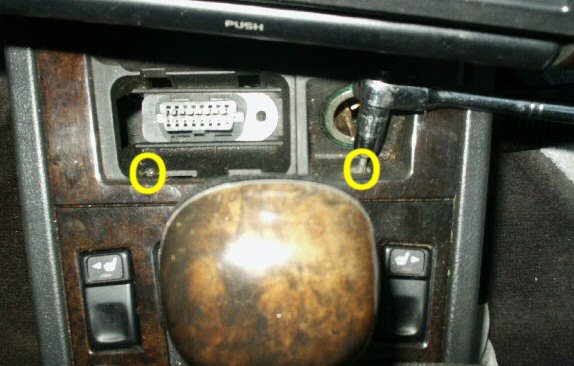
Last edited by rspi; Oct 20, 2011 at 02:26 PM. Reason: pic
Super Moderator
Joined: May 2009
Posts: 2,702
Likes: 1
From: Rocklin, Ca
Depends on what the production date of your 94 is. You may be at the crossroads point. Just look at your coin holder next to the Cig lighter. Does it say OBDII on it? The port is under the coin tray.
Administrator
Joined: Mar 2010
Posts: 4,517
Likes: 12
From: Cape Coral, FL
Grabbed this from matthewsvolvosite.com
The gas filter is located passenger side just forward of the rear axle. The band that holds the gas filter in place is a pinch band that has a nut welded/formed into it on the back/top side. A 12 mm bolt holds the band in place. The top of the band has a bracket that hold the return fuel line - this just pops off and the return fuel line can be reattached once the filter has been replaced. If your filter has never been replaced there is masking tape covering the pinch connections at both ends of the filter. Remove the masking tape. You need to put a pan under the old filter to catch any gas spillage - it will be minimal. Also the new filter comes with plastic caps on the ends of the new filter - you will want to use them to plug the old filter connectors so you need to take them off the new filter to have handy. There is a T off the fuel rail that has a cap on it - remove the cap and press the needle in to relieve any pressure that is on the gas line. Use eye protection and bleed the gas into a rag or small cup - If it has been setting for an hour there will probably be very little if any pressure on the line. You can skip messing with the T and you will see about an ounce of fuel that will come out of the filter when you remove the hose.
To remove the connectors push the connector ring away from the filter housing. (I did the front first because I had more room). I used a paint can opener to help pry the hose away from the filter - it is shaped like a can opener but without a cutting edge - a large flat screwdriver would perform as well. It is a tight fit but once it starts to move it will come off. Once the hose is off use the plastic caps you took off the new filter to help hold the gas in the old filter. After removing both ends remove the holding band and place it on the new filter. The two lines will go back on easier than they came off, just push them onto the filters nipples. Put the 12 mm bolt back into the pinch band and reintall the return fuel line. Wipe any stray fluids and your done.
The gas filter is located passenger side just forward of the rear axle. The band that holds the gas filter in place is a pinch band that has a nut welded/formed into it on the back/top side. A 12 mm bolt holds the band in place. The top of the band has a bracket that hold the return fuel line - this just pops off and the return fuel line can be reattached once the filter has been replaced. If your filter has never been replaced there is masking tape covering the pinch connections at both ends of the filter. Remove the masking tape. You need to put a pan under the old filter to catch any gas spillage - it will be minimal. Also the new filter comes with plastic caps on the ends of the new filter - you will want to use them to plug the old filter connectors so you need to take them off the new filter to have handy. There is a T off the fuel rail that has a cap on it - remove the cap and press the needle in to relieve any pressure that is on the gas line. Use eye protection and bleed the gas into a rag or small cup - If it has been setting for an hour there will probably be very little if any pressure on the line. You can skip messing with the T and you will see about an ounce of fuel that will come out of the filter when you remove the hose.
To remove the connectors push the connector ring away from the filter housing. (I did the front first because I had more room). I used a paint can opener to help pry the hose away from the filter - it is shaped like a can opener but without a cutting edge - a large flat screwdriver would perform as well. It is a tight fit but once it starts to move it will come off. Once the hose is off use the plastic caps you took off the new filter to help hold the gas in the old filter. After removing both ends remove the holding band and place it on the new filter. The two lines will go back on easier than they came off, just push them onto the filters nipples. Put the 12 mm bolt back into the pinch band and reintall the return fuel line. Wipe any stray fluids and your done.

Thread
Thread Starter
Forum
Replies
Last Post
Jeffers
Volvo S80
0
Nov 21, 2012 06:50 PM
