


car stalls


Member
Joined: Oct 2009
Posts: 86
Likes: 0
From: California

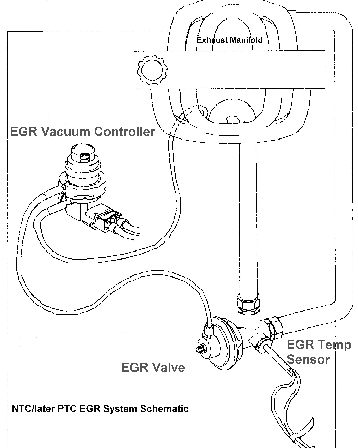
Does your car have an EGR? Generally 1995 and below does, and sometimes 1996. It's a part with a copper hose going to it and it hangs down from your throttle body.
There should be a vacuum line running from a nipple on the EGR up to a controller on the radiator shroud and a line running from the controller to the main vacuum tree on the throttle body.
Now, having your EGR disconnected isn't going to cause the car to stall (I've accidentally driven around with vacuum tree plugs off and the car never stalled), it's going to cause crankcase pressure when the engine is at operating temp. While your car is a operating temperature pull out your dipstick about an inch and see if any vapor is coming out. This could indicate that your EGR is clogged or is not functioning.
Your MAF sounds like a likely culprit, especially since you said it got better when you unplugged/cleaned it. The part could still be faulty and need replacing. Do you have a multimeter?
There should be a vacuum line running from a nipple on the EGR up to a controller on the radiator shroud and a line running from the controller to the main vacuum tree on the throttle body.
Now, having your EGR disconnected isn't going to cause the car to stall (I've accidentally driven around with vacuum tree plugs off and the car never stalled), it's going to cause crankcase pressure when the engine is at operating temp. While your car is a operating temperature pull out your dipstick about an inch and see if any vapor is coming out. This could indicate that your EGR is clogged or is not functioning.
Your MAF sounds like a likely culprit, especially since you said it got better when you unplugged/cleaned it. The part could still be faulty and need replacing. Do you have a multimeter?

Administrator
Joined: Mar 2010
Posts: 4,517
Likes: 12
From: Cape Coral, FL
"it's going to cause crankcase pressure when the engine is at operating temp. While your car is a operating temperature pull out your dipstick about an inch and see if any vapor is coming out. This could indicate that your EGR is clogged or is not functioning."
I don't think so. Everything else is good but this sentence is a little misleading and might get confused with having a poorly performing PCV system.
The EGR valve is connected to the exhaust and intake. When it's not working it doesn't affect exhaust nor does it affect the intake.
When it is working and the valve opens it allows the intake's vacuum to suck in exhaust gas to dilute the intake air fuel mix and allow the engine to run a little cooler by diluting that mix and offering less gasoline for combustion. In doing so it reduces the combustion temperature lowering emissions.
It isn't connected in any way to the crankcase nor would it while working, malfunctioning, disconnected or even removed have any effect on crankcase pressure or the lack of.
IMHO I think you have the PCV and EGR a little confused on that one statement of crankcase pressure.
I don't think so. Everything else is good but this sentence is a little misleading and might get confused with having a poorly performing PCV system.
The EGR valve is connected to the exhaust and intake. When it's not working it doesn't affect exhaust nor does it affect the intake.
When it is working and the valve opens it allows the intake's vacuum to suck in exhaust gas to dilute the intake air fuel mix and allow the engine to run a little cooler by diluting that mix and offering less gasoline for combustion. In doing so it reduces the combustion temperature lowering emissions.
It isn't connected in any way to the crankcase nor would it while working, malfunctioning, disconnected or even removed have any effect on crankcase pressure or the lack of.
IMHO I think you have the PCV and EGR a little confused on that one statement of crankcase pressure.
Last edited by Kiss4aFrog; Jun 4, 2013 at 09:23 PM.

Thread Starter
|
Junior Member
Joined: Mar 2013
Posts: 10
Likes: 0
I don't think I see the egr in here, the main thing im using to try to identifiy it is looking for a copper wire however. Now this is a 97, based on your description I think that it would be unusual for me to have one under the hood?
I did say the car ran much better with the MAF unplugged, and then it ran much much better after I cleaned the MAF.
The thing is I do have a rather small sample size, you see the issue I was having was rather intermittent but it would follow a pattern.
1. car would start fine in the morning, but as I had to come to a couple stops on the way to work the RPM's would start hesitating.
2. I would usually stop at the store on the way to work, when I come back out to my car I would have difficulty starting it, requiring me to push on the case and crank the car for like 10 seconds to start. (note this step was extremely consistant the last week the problem as occurring)
3. after this difficulty starting the rest of the ride to work would be difficult with the car acting like it was going to turn off.
4. after working for 8 hours this step is very much like step 1.
5. on my way home from work this is very much like step 2
In any case when I had the MAF unplugged there was absolutely no problem starting the car, and the RPM's ran relatively stable. but it did stall out one time. And after I cleaned the MAF everything seemed great, but there was one instance of the car not wanting to start. and since I have now cleaned the MAF and plugged that line back in there has been no problems, but I have only driven a few times, so I am kind of in a monitoring stage.
As of right now I am monitoring, but I also have some spark plugs on order because I figure they cant hurt. You mentioned the multimeter, is there a test I can run with this to check on the status of the MAF?
I did say the car ran much better with the MAF unplugged, and then it ran much much better after I cleaned the MAF.
The thing is I do have a rather small sample size, you see the issue I was having was rather intermittent but it would follow a pattern.
1. car would start fine in the morning, but as I had to come to a couple stops on the way to work the RPM's would start hesitating.
2. I would usually stop at the store on the way to work, when I come back out to my car I would have difficulty starting it, requiring me to push on the case and crank the car for like 10 seconds to start. (note this step was extremely consistant the last week the problem as occurring)
3. after this difficulty starting the rest of the ride to work would be difficult with the car acting like it was going to turn off.
4. after working for 8 hours this step is very much like step 1.
5. on my way home from work this is very much like step 2
In any case when I had the MAF unplugged there was absolutely no problem starting the car, and the RPM's ran relatively stable. but it did stall out one time. And after I cleaned the MAF everything seemed great, but there was one instance of the car not wanting to start. and since I have now cleaned the MAF and plugged that line back in there has been no problems, but I have only driven a few times, so I am kind of in a monitoring stage.
As of right now I am monitoring, but I also have some spark plugs on order because I figure they cant hurt. You mentioned the multimeter, is there a test I can run with this to check on the status of the MAF?
Member
Joined: Oct 2009
Posts: 86
Likes: 0
From: California
97's were equipped with an air-pump instead of an EGR so I'm not really sure what that vacuum line going to the shroud is.
It does really sound like a faulty MAF from what your describing, it seems like the sensor starts to give out faulty signals as it heats up which causes the car to stall or be hard to start. The fact that it runs BETTER without the MAF directly indicates that there is a problem with the sensor, however it is still normal to stall with the sensor disconnected because there is no signal to tell the computer how much air is going into the intake.
I'll test mine out to see what readings I get but If I had to guess you should get 0 Ohms when testing the sensor pins, and you should get some sort of a voltage reading while the car is running. But again I'll check that out so I can get you exact numbers. Hopefully it's fixed after that cleaning though and the monitoring stage can become the repaired stage
It does really sound like a faulty MAF from what your describing, it seems like the sensor starts to give out faulty signals as it heats up which causes the car to stall or be hard to start. The fact that it runs BETTER without the MAF directly indicates that there is a problem with the sensor, however it is still normal to stall with the sensor disconnected because there is no signal to tell the computer how much air is going into the intake.
I'll test mine out to see what readings I get but If I had to guess you should get 0 Ohms when testing the sensor pins, and you should get some sort of a voltage reading while the car is running. But again I'll check that out so I can get you exact numbers. Hopefully it's fixed after that cleaning though and the monitoring stage can become the repaired stage
Last edited by tobolate; Jun 2, 2013 at 12:22 PM.
Member
Joined: Oct 2009
Posts: 86
Likes: 0
From: California
"it's going to cause crankcase pressure when the engine is at operating temp. While your car is a operating temperature pull out your dipstick about an inch and see if any vapor is coming out. This could indicate that your EGR is clogged or is not functioning."
I don't think so. Everything else is good but this sentence is a little misleading and might get confused with having a poorly performing PCV system.
The EGR valve is connected to the exhaust and intake. When it's not working it doesn't affect exhaust non does it affect the intake.
When it is working and the valve opens it allows the intake's vacuum to suck in exhaust gas to dilute the intake air fuel mix and allow the engine to run a little cooler by diluting that mix and offering less gasoline for combustion. In doing so it reduces the combustion temperature lowering emissions.
It isn't connected in any way to the crankcase nor would it while working, malfunctioning, disconnected or even removed have any effect on crankcase pressure or the lack of.
IMHO I think you have the PCV and EGR a little confused on that one statement of crankcase pressure.
I don't think so. Everything else is good but this sentence is a little misleading and might get confused with having a poorly performing PCV system.
The EGR valve is connected to the exhaust and intake. When it's not working it doesn't affect exhaust non does it affect the intake.
When it is working and the valve opens it allows the intake's vacuum to suck in exhaust gas to dilute the intake air fuel mix and allow the engine to run a little cooler by diluting that mix and offering less gasoline for combustion. In doing so it reduces the combustion temperature lowering emissions.
It isn't connected in any way to the crankcase nor would it while working, malfunctioning, disconnected or even removed have any effect on crankcase pressure or the lack of.
IMHO I think you have the PCV and EGR a little confused on that one statement of crankcase pressure.
I think you're right, the PCV system or a dirty PTC is generally the culprit of smoking dipsticks on these cars. However the can't the EGR can add to it? I agree that JUST the EGR not functioning generally would not cause excessive pressure though.
I remember when I had a problem with excessive crankcase pressure people kept telling me to clean/check the EGR.
Administrator
Joined: Mar 2010
Posts: 4,517
Likes: 12
From: Cape Coral, FL
I think sometimes people just get confused, I know I do. And if you're just learning and we are tossing all these MAFs, IACs, PCVs ..... at you they all get a little confused.
But you are right. Crankcase pressure or having the oil dipstick smoke is usually a sign of a restricted PCV black box, restricted or collapsed vac hose or if it's a turbo the PTC valve.
But you are right. Crankcase pressure or having the oil dipstick smoke is usually a sign of a restricted PCV black box, restricted or collapsed vac hose or if it's a turbo the PTC valve.

Thread
Thread Starter
Forum
Replies
Last Post
